Seen in the window at Gulf of Maine Books in Brunswick, Maine.
Photo: Bill Roorbach
Except America wasn’t an endless expanse of forest with no certain borders. At least not while human beings inhabited it. The idea that native peoples did not cultivate or shape our land and that we had no borders is white propaganda meant to dehumanize and de-legitimize native peoples.
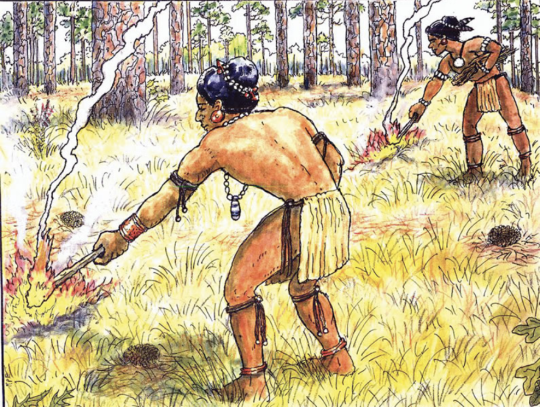
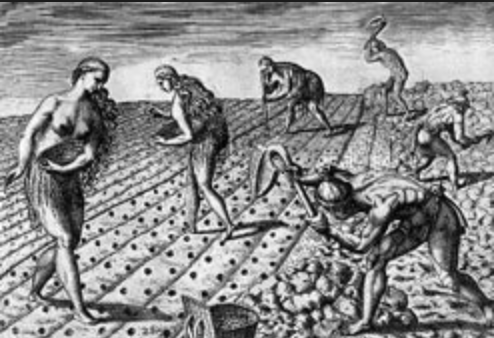
This illustration here show Apalachee people using slash and burn methods for agriculture. Fires were set regularly to intention burn down forests and plains. Why would we do this? Well because an unregulated forest isn’t that great for people, actually. We set fires to destroy new forest growth and undergrowth, and to remove trees, allowing for easier game hunting, nutrient enriched soil, and better growth rates for crops and herbs we used in food and medicine.
Pre-Colonial New England, where my tribe the Abenaki are from, looked more like an extensive meadow or savannah with trees growing in pockets and groves. Enough woodland to support birds, deer, and moose, but not too much to make hunting difficult. We carefully shaped the land around us to suit our needs as a thriving and successful people. Slash and burn agriculture was practiced virtually everywhere in the new world, from the pacific coast to chesapeake bay, from panama to quebec. It was a highly successful way of revitalizing the land and promoting crop growth, as well as preventing massive forest fires that thrive in unregulated forests. Berries were the major source of fruit for my tribe, and we needed to burn the undergrowth so they could grow.
That changed when white people invaded, and brought with them disease. In my tribe, up to 9 in 10 people died. 90% of our people perished not from violence starvation, but from disease. Entire villages would be decimated, struck down by small pox. Suddenly, we couldn’t care for the land anymore. There weren’t enough of us to maintain a vast, carefully structured ecological system like we had for thousands of years. We didn’t have the numbers, or strength. So the trees grew back and unregulated. We couldn’t set fires anymore, and we couldn’t cultivate the land. And white people would make certain we never could again. Timber, after all, was the most important export from New England.
Endless trees and untamed wilderness is a nice fantasy. But it’s a very white fantasy, one that erases the history of my people and of my land. One that paints native peoples are merely parasites leeching off the land, not masters of the earth who new the right balance of hunting and agriculture. It robs us of our agency as people, and takes our accomplishments from us. Moreover, it implies that only white people ever discovered the power to shape the world around them, and that mere brown people can’t possibly have had anything to do with changing our environment.
Don’t bring back untamed wilderness. Bring back my fire setters, my tree sappers, my farmers and my fishers. Bring back my people who were here first.
3. Documents obtained by the ACLU show massive horrific abuse of children in ICE custody, including kicking a child in the ribs, running over a 17 year old with a patrol car, sexually assaulting a 16 year old girl in a search, and detaining a 4 pound premature baby and her mother in an overcrowded and dirty cell full of sick people. (More here: https://www.aclusandiego.org/civil-rights-civil-liberties/)
ICE was only created in 2003, as part of the US’s post-9/11 hyper-militarized, xenophobic frenzy. We didn’t have this department 16 years ago, we do not need it, and we should abolish it immediately. I do not say this lightly: ICE is America’s gestapo and we should treat them with that level of serious resistance.
Female cinematographers: Rachel Morrison Black Panther (2018) Directed by Ryan Coogler Aspect Ratio: 2.39 : 1
“If there’s anything consistent about my work it’s not flat. The criticism of Marvel movies whether it’s in the cinematography or in the Digital Intermediate is that sometimes sort of lack contrast and saturation. That certainly isn’t true of my work from the outset, so hopefully the look we’re presenting will hold through to the end. But I think in making something so big, if you take for example an exterior day scene that’s shot over 15, 20 days you’re not gonna have all sunny days so what happens at the end of shooting when it’s half sun and half cloud. The natural tendency is to lean into something in the middle, to kind of flatten out the contrast on the sunny day and maybe try to bump up the contrast on the cloudy day and find somewhere to meet in the middle. That was my biggest concern going in was that we don’t allow that to happen, so we would throw hard light at people on cloudy days just to kind of increase the contrast.” — Rachel Morrison


 tora42's nonsensne