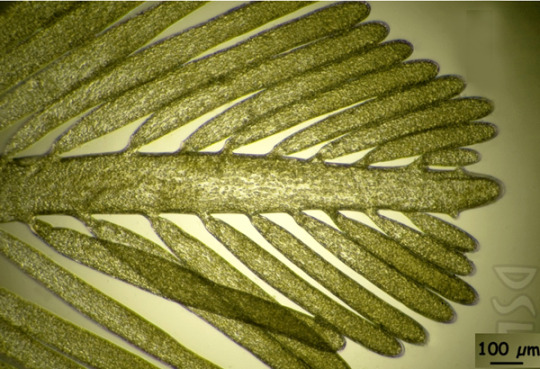
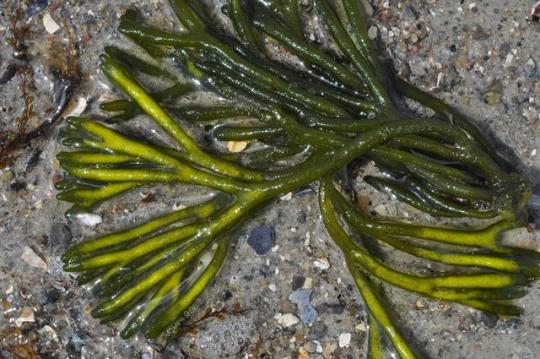
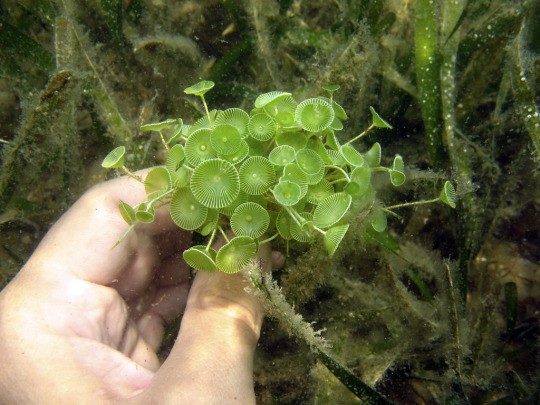
I see doubt in the notes so just wanted to say that YES, this is a unicellular organism! This is a species from a genus of green algae called Caulerpa, which are a siphonous algae. The frond shapes, the “rhizomes” it grows from, and the “roots” it extends into substrate are all extensions of a single multi-nucleate cell. Here’s what a siphonous alga looks like under a microscope, with no divisions in its cytoplasm:
It’s not the only algae like this, either! Caulerpa is a member of order Bryopsidales, which are all siphonous. Here’s some more macroscopic single cell algae:
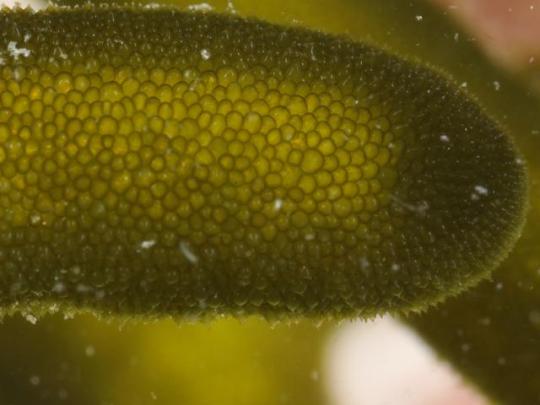
Codium fragile, or dead man’s fingers. This one is a single long noodle of a cell with swollen growths on the outside called urtricles, packed together to create a firm “skin.”
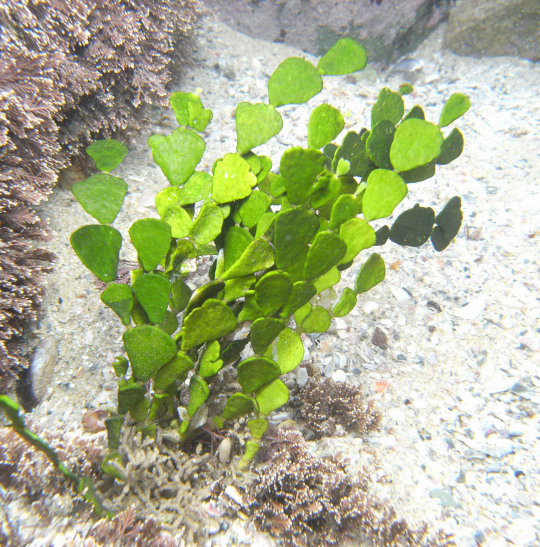
Halimenia, a calcified algae whose shed growths are responsible for a lot of the beautiful white sand on tropical beaches:
So you know how groups of animals sometimes have weird names, like a flamboyance of flamingos or a shrewdness of apes? What if we did that with academic disciplines too?
Here is a timeline of the evolution of Dullahan
(aka Headless Horseman) art and aesthetics. For additional context, I’ve
included notes on mythology and folklore. This is not a comprehensive list, but rather a general sampling of changing Dullahan design.
P.S. If anyone has any examples of jhinjhār
art (headless horseman myth from India), please hook me up.
It literally just occurred to me that Ghost Rider, Spirit of Vengeance, is a riff on the headless horseman.
“True, and if I was driven solely by revenge, that might give me pause – but I’m also driven by the fact that you’re just generally a terrible person.”



 tora42's nonsensne