The boy sits there, his head down. He feels stink; he knows all the adults are there to talk about him, about what’s wrong with him.
He’s always been told off for being so fidgety, for not paying attention. He knows it’s a bad thing.
But when the talking begins, it’s not about how to fix him. They’re telling a story about atua, the gods, and one of them sounds exactly like him! He’s called Uepoto, and he’s always curious. He’s full a mischief, a tutū.
The boy looks up.
“That’s where the healing starts, with an exchange of words,” says Poutu Puketapu, 25, a mental health worker at Gisborne service Te Kūwatawata. Only, that’s not his title here – in this space he’s a Mataora, or change-maker.
And the boy isn’t a patient, or client, or even a consumer. He is simply whānau.
“Instead of labelling them and making them feel like they are part of the mental health system, we reach them with these narratives. When they hear the pūrākau (stories) you see a little spark in them.”
Mahi a Atua is a form of narrative therapy that focuses on recovery from the trauma of colonisation. Māori creation stories are used as a form of healing, connecting alienated Māori to their whakapapa.
The pilot programme began in August last year as a response to the disproportionate mental health issues among Māori, and is backed by the Ministry of Health’s innovation fund and Hauora Tairāwhiti District Health Board.
Māori youth are two-and-a-half times more likely than non-Māori to commit suicide. Māori in general are more often underdiagnosed, and once in the mental health system are more likely to be secluded and imprisoned.
Mahi a Atua is driven by Dr Diana Kopua, an Otago University Māori health academic and clinician who is Head of Psychiatry at the DHB, and her husband Mark Kopua, a tohunga and Tā Moko practitioner.
We, as colonizers, have spent generations engaging in a project of destruction and suppression of indigenous languages and stories. We have dismissed them as mere superstition, instead of highly conserved forms of identity and epistemology. Indigenous knowledge of identity, local flora, fauna, and the Deep Time of the landscape, narratives of self-and-Other providing insight into complex ecological relationships – all these are beginning to be (grudgingly) acknowledged as not only useful, but in some sense ‘necessary’ for wellbeing.
The mythopoetic arises from gnosis – the point of contact between living environment and humanity. For indigenous peoples, I suspect the gnostic interplay stretches for hundreds if not thousands of years – or at least would have, had we not, as colonizers, attempted to break and shatter those links which ran throughout Deep Time in an effort to reduce those peoples in service to capital and authoritarianism.
Ironically, we have even had these weapons turned back upon ourselves – the colonizing peoples having their own localised and highly specific forms of knowledge destroyed or dismissed unless their narrative power could be made to serve State or Corporate Imperialism.
To quote Ursula K. Le Guin: “A writer is a person who cares what words mean, what they say, how they say it. Writers know words are their way towards truth and freedom, and so they use them with care, with thought, with fear, with delight. By using words well they strengthen their souls. Story-tellers and poets spend their lives learning that skill and art of using words well. And their words make the souls of their readers stronger, brighter, deeper.”
Long live the tales of the Maori – and their tellers!
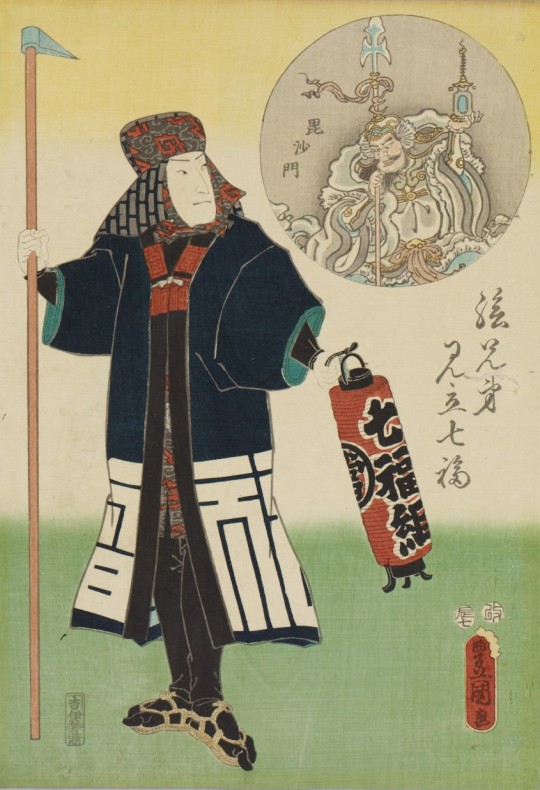
Fun fact: That is made with real indigo grown on a farm.
The heat index real indigo can take is up to 1500 degrees Fahrenheit, which is why it was used for centuries.
Another fun fact: Japanese firefighters were hardcore and very proud of their job and abilities. If anyone is interested, I can dig out some amazing images.
Okay guys, so here it is: History lesson about the firemen in Edo, Japan. (Because I need to impart some knowledge before I get to the fun part.)
Edo (now Tokyo) in the 17th century had some massive problems. The city had only become the official capital in 1603. Before the 16th century, it had been an inconsequental fishing town. After becoming the capital, the city boomed and population more or less exploded.
The numbers I could find are the following:
1640: 400′000 residents
1693: 800′000 residents
1721: 1′100′000 residents
All in all, Edo became a massive, sprawling city in a very short amount of time. All kinds of people came to Edo, from poor women that were literally sold into prostiution by their parents to the leaders of the country.
The rapid population growth wasn’t the only problem the city faced, however. Some other factors include:
Building material: Most houses were built almost entirely out of wood, which, surprise, burns easily.
Building structures: Houses were often built in rows, with narrow streets in between, perfect for the quick spread of fire
Weather: Constant strong winds, especially in the winter and in spring, helped along with that, too
Arson: Yes, people literally set fires in the hope that they would manage to loot something valuable in the process. These people were often from the lower strata of society, showing that not all was well in Edo. (In short: being poor sucks massively.) Sometime merchants just wanted to destroy their rival’s business, though. Burn that fucker to the ground, or something like that.
Due to these factors, the city experienced 49 large fires between 1601 and 1867, and over a thousand smaller fires. Which means there were approximately 7 smaller fires a year, as well as one massive fire every five years… not great odds if you just wanna do your thing in the big city. The largest fire in 1657 killed around 100′000 people, which was, if you look at the numbers up there, probably around a quarter of the population.
While the shogun quickly commanded the creation of a firefighting force to prevent the burning of his buildings, he was less concerned about the rest of the city. It took until the 18th century (I think somewhere in the 1720s) until he finally ordered the creation of a city-wide firefighting force that protected people from fires and put them out.
In short, because of the frequency of the fires, this was a massively important job.
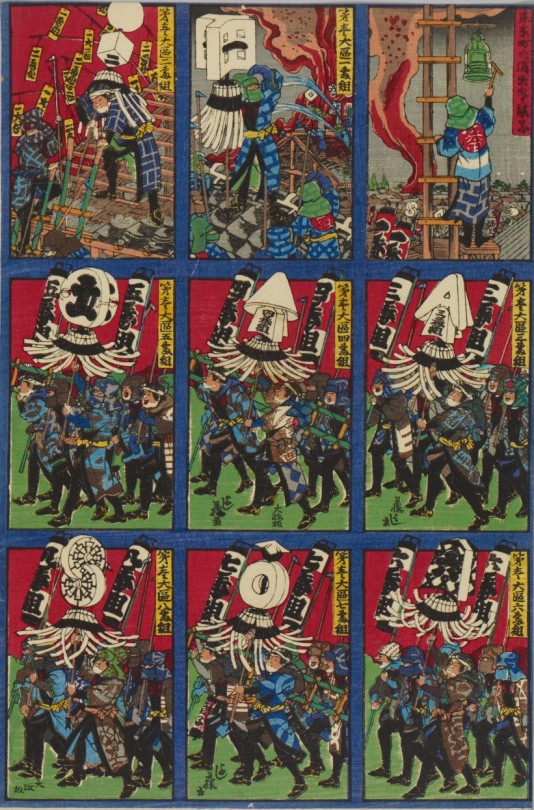
(Above: Fireman in gear. Take note of the fire hook. These hooks were standard gear for any firefighter, and usually used to destroy buildings to prevent the spread of a fire.)
(Above: Firemen at work. The lanterns and the matoi they are carrying are symbols to identify the “department”.)
And I don’t know, but it seems like an universal rule that important people like to show off, or maybe it’s just a side-effect of running into rapidly-spreading fires, but at some point, they started the tradition of “ladder climbing.” It’s now part of a yearly ceremony that takes place just after new years, but the exact origin of this tradition is unclear.
(Above: We have no time for your foolish safety measures. Get on our level. Hahahaha.)
Anyway, what they do every year in this ceremony is this:
One or more dudes climb a straight ladder that’s only secured with the fire hooks of their colleagues on the ground (you can see them do that in the image), and on top of that ladder they perform various acrobatic feats to show off their awesome firefighting skills (not really). Now if you say this is obviously a print and does not depict reality at all, let me direct you towards some newer technology:
(Above: AAAAH.)
And the tradition lives on until today:
(Above: You can also clearly see this goddamn ladder is not secured at all, other than with the fire hooks. You can only hope none of your colleagues are planning to murder you.)
And if you want to see the entire thing in movement:
In this video, you can see some very nice close-ups of the ladder and the way it’s being secured by the fire hooks. The best stunts come towards the end. Here you can see three dudes on the ladder, and here’s a video of a woman doing the stunts.
Honestly, I could go on enternally, but there you go. The badass firefighters of ye olde Japan.














 tora42's nonsensne