Greetings friends! The midterms are so close, are you registered to vote?
You: I can’t vote, I’m an Ex-Offender
ARE YOU SURE?
I live in Vermont or Maine: You never lost your right to vote
I live in DC, Hawai’i, Illinois, Indiana, Maryland*, Massachusetts, Michigan, Montana, New Hampshire, North Dakota, Ohio, Oregon, Pennsylvania, or Utah: You can vote upon your release from incarceration.
That’s cool but I don’t live in those states. I live in: Alaska, Arkansas, California, Colorado, Connecticut, Georgia, Idaho, Kansas, Louisiana, Minnesota, Missouri, New Jersey, New Mexico, New York, North Carolina, Oklahoma, South Carolina, South Dakota, Texas, Washington (state), West Virginia.: You can vote once you have completed your sentence (parole and/or probation)
Wow! That’s really cool. But, um. I don’t live in those states. I live in:
Alabama: You cannot vote if you have been convicted of any felony listed here. Crimes of ‘moral turpitude’ including: Murder, Manslaughter, Kidnapping, Rape, Sodomy, Sexual Torture/Abuse
Arizona: First time offender? Complete your probation and payment of any fine or restitution and you can vote. Multiple Offender? You have to apply to a judge to vote.
Delaware You cannot vote if you have been convicted of murder, bribery or sexual offenses. If you have been pardoned or had your sentence completed, get your vote on!
Florida Rights must be restored via the governor and a clemency board. In the November elections Floridians have the opportunity to vote for Amendment Four and restore voting rights to over a million Floridians. So that man that threw an alligator at someone can vote?? YES but so can your dumb little brother who thought carrying a concealed weapon would be cool when he was 19. So can the drug addict who robbed a convenience store but has been clean for 20 years.
Iowa You must petition the governor
Kentucky You must petition the governor
Mississippi If you have committed one of the following crimes: armed robbery, arson, bigamy, bribery, carjacking, embezzlement, extortion, felony bad check, felony shoplifting, forgery, larceny, murder, obtaining money or goods under false pretense, perjury, rape, receiving stolen property, robbery, statutory rape, theft, timber larceny, and unlawful taking of a vehicle. you cannot vote unless a bill passed by both houses of the legislature or through the governor. If you did NOT commit one of those crimes, you can vote even while incarcerated
Nebraska Voting rights are automatically restored two years after the completion of all supervised release
Nevada Voting rights are restored automatically after sentence completion if convicted of a non-violent felony. However, those convicted of a violent felony and all second-time felony offenders (whether violent or non-violent) can only have their rights restored by the court in which they were convicted.
Tennessee Individuals convicted of a felony since 1981–except for some felonies such as murder, rape, treason and voter fraud–may apply to the Board of Probation and Parole to have their voting rights restored once their sentence is completed.
Virginia: You can vote if you completed your sentence, including probation and parole. This is not a law but an order by the governor. A new governor can repeal this.
Wisconsin-Voting rights are automatically restored upon completion of all supervised release
Wyoming- Voting rights restoration is dependent on the type of conviction: first-time non-violent felony offenders can apply to the Wyoming Board of Parole five years after completion of sentence. All others must apply to the Governor for either a pardon or a restoration of rights, but must wait ten and five years, respectively, after completing their sentence.
In many cases you must RE-REGISTER to vote but you can vote.
*If you are guilty of buying or selling votes, you have to get the governor to pardon you.
This is not intended to be comprehensive, you should check out your state’s laws for any quirks.
Remember people of color are disproportionately incarcerated. Double check you may be able to make your voice heard
The United States is a democratic republic, but our elections are an absolute mess. In an ideal democracy (either direct or republic), as close to 100% of adult citizens should be voting in every election, and the results should be as representative as possible. Here are some ways to work towards that:
1. Automatic voter registration. All adult citizens should automatically be on the voter lists. This means no one is denied the right and responsibility to vote because they were unable to register on time.
2. Mail In Ballots should be automatic and available for all. (Mail In ballots allow for people with busy schedules who would struggle to get to voting places to vote, but also allows voters the time to fully research all of the candidates and issues at their own pace.)
3. Voting rights should not be denied to anyone based on criminal record. (Felons and inmates should be allowed to vote, as they are still citizens. Especially given issues of racial inequality within the criminal justice system AND how things like drug laws are inconsistent across the states, it is not reasonable to deny this right and responsibility from people with criminal backgrounds.)
4. Voting should be obligatory.(While filing out a ballot with “abstain” on it will remain legal and allowable, a ballot MUST be submitted or else is punishable by a fine proportional to the person’s income. This encourages participation and awareness in elections, and also legally obligates the government to take further action to make voting universally available.)
5. Switch to either Ranked Voting systems (For elections with only 1 open seat) or Party Proportional Voting (For elections with multiple open seats) to promote more representative results and empower voting for 3rd party candidates.
7. For Presidential Elections, eliminate the Electoral College and move to a Ranked Voting System. (The Electoral College means that only the large cities in a few swing states states have real voting power in Presidential Elections, disincentives candidates from visiting the “safe” states, gives some citizens votes more power than others, erases the votes of political minorities within states, and puts us at risk of having a winner that is not representative of the majority of voters, which has happened 5 times.)
8. Extend the voting period of elections over several days, including at least 1 federal holiday. (This is less important if universal mail in ballots are enacted, but is a good alternative, allowing more people to be able to get to a polling place.)
10. Fixing heavily gerrymandered districts. (Depending on how an implementation of Party Proportional Voting was implemented, the need for specific districts could be phased out, but should they remain, all voting districts would need non-partisan review at least once a decade to ensure gerrymandering wasn’t at work.)
I like this list, but I think mandatory voting needs to wait until well after all the measures to make voting easier are solidly in place and we’ve had time to get the bugs out of them. Voting needs to be a lot easier than it is now before we start penalizing people for not voting.
(And yes, “abstain” absolutely needs to be an option if voting is to be mandatory.)
Agreed. Its not something that can be put in place in isolation. It needs the support of other reforms to work, and abstaining should always be valid.
Hell, Ive seen proposals that if there is too high a percentage of “I abstain because I hate both of these/all of these choices” votes, that there needs to be a new election.
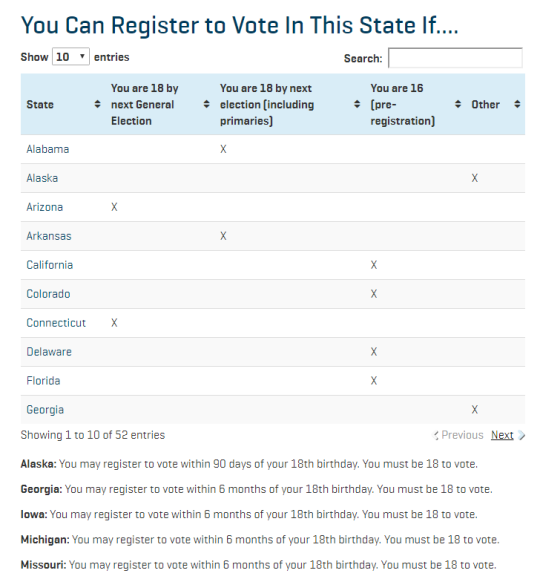
“Think you’re not old enough to register to vote? If you’re 17 and will be 18 by Election Day, chances are you can. Check out our chart below that details when you are eligible to register or preregister in your state, and when you can start voting!”
The info’s all at the site, in table format, but here it is on your dash as a list. The 50 states, Washington, D.C., and Puerto Rico, all alphabetized.
Alabama: you may register to vote if you are 18 by the next election, including primaries.
Alaska: you may register to vote within 90 days of your 18th birthday. You must be 18 to vote.
Arizona: you may register to vote if you are 18 by the next General Election.
Arkansas: you may register to vote if you are 18 by the next election, including primaries.
California: you may pre-register to vote if you are 16.
Colorado: you may pre-register to vote if you are 16.
Connecticut: you may register to vote if you are 18 by the next General Election. Registered 17 year-olds who will be 18 by the general election can vote in primaries.
Delaware: you may pre-register to vote if you are 16. Registered 17 year-olds who will be 18 by the general election can vote in primaries.
Florida: you may pre-register to vote if you are 16.
Georgia: you may register to vote within 6 months of your 18th birthday. You must be 18 to vote.
Hawaii: you may register to vote if you are 18 by the next election, including primaries.
Idaho: you may register to vote if you are 18 by the next election, including primaries.
Illinois: you may register to vote if you are 18 by the next General Election. Registered 17 year-olds who will be 18 by the general election can vote in primaries.
Indiana: you may register to vote if you are 18 by the next General Election.
Iowa: you may register to vote within 6 months of your 18th birthday. You must be 18 to vote.
Kansas: you may register to vote if you are 18 by the next election, including primaries.
Kentucky: you may register to vote if you are 18 by the next election, including primaries. Registered 17 year-olds who will be 18 by the general election can vote in primaries.
Louisiana: you may pre-register to vote if you are 16.
Maine: you may register to vote if you are 18 by the next General Election. Registered 17 year-olds who will be 18 by the general election can vote in primaries.
Maryland: you may pre-register to vote if you are 16. Registered 17 year-olds who will be 18 by the general election can vote in primaries.
Massachusetts: you may pre-register to vote if you are 16.
Michigan: you may register to vote within 6 months of your 18th birthday. You must be 18 to vote.
Minnesota: you may register to vote if you are 18 by the next election, including primaries.
Mississippi: you may register to vote if you are 18 by the next election, including primaries. Registered 17 year-olds who will be 18 by the general election can vote in primaries.
Missouri: you may register to vote within 6 months of your 18th birthday. You must be 18 to vote.
Montana: you may register to vote if you are 18 by the next election, including primaries.
Nebraska: you may register to vote if you are 18 by the next General Election. Registered 17 year-olds who will be 18 by the general election can vote in primaries.
Nevada: you may register to vote if you are 18 by the next election, including primaries.
New Hampshire: you may register to vote if you are 18 by the next election, including primaries.
New Jersey: you may register to vote if you are 18 by the next General Election.
New Mexico: you may register to vote if you are 18 by the next General Election. Registered 17 year-olds who will be 18 by the general election can vote in primaries.
New York: you may register to vote if you are 18 by the next General Election.
North Carolina: you may pre-register to vote if you are 16. Registered 17 year-olds who will be 18 by the general election can vote in primaries.
North Dakota: does not have voter registration. You must be 18 to vote.
Ohio: you may register to vote if you are 18 by the next General Election. Registered 17 year-olds who will be 18 by the general election can vote in primaries.
Oklahoma: you may register to vote if you are 18 by the next election, including primaries.
Oregon: you may pre-register to vote if you are 16.
Pennsylvania: you may register to vote if you are 18 by the next election, including primaries.
Puerto Rico: you may register to vote if you are 18 by the next General Election.
Rhode Island: you may pre-register to vote if you are 16.
South Carolina: you may register to vote if you are 18 by the next election, including primaries. Registered 17 year-olds who will be 18 by the general election can vote in primaries.
South Dakota: you may register to vote if you are 18 by the next election, including primaries.
Tennessee: you may register to vote if you are 18 by the next election, including primaries.
Texas: you may register to vote within 2 months of your 18th birthday. You must be 18 to vote.
Utah: you may pre-register to vote if you are 16.
Vermont: you may register to vote if you are 18 by the next General Election. Registered 17 year-olds who will be 18 by the general election can vote in primaries.
Virginia: you may register to vote if you are 18 by the next General Election. Registered 17 year-olds who will be 18 by the general election can vote in primaries.
Washington: you may register to vote if you are 18 by the next election, including primaries.
Washington D.C.: you may register to vote if you are 18 by the next General Election.
West Virginia: you may register to vote if you are 18 by the next General Election. Registered 17 year-olds who will be 18 by the general election can vote in primaries.
Wisconsin: you may register to vote if you are 18 by the next election, including primaries.
Wyoming: you may register to vote if you are 18 by the next election, including primaries.


 tora42's nonsensne