This is part of my webcomic Postcards in Braille, which you can read on ComicFury or Tapastic. Updates on Mondays!
This comic/guide works well enough on its own, so I thought it’d be nice to post it here as well 😀 Braille is really cool and you don’t need to be blind or visually impaired to learn it – and spreading the use of Braille can help us build a more inclusive society! everyone wins!
Bonus fun fact: Braille is originally based on Night writing (or sonography), a tactile reading/writing system created for soldiers to communicate silently at night. Louis Braille adapted it into easier to read cells, creating the Braille system. Good to know it evolved into something so useful!
why caffeine works for some of us, but not all, and even then it often depends on the way you take it and the dosage
how come all of us have gastrointestinal problems?
addendum to the above: what exactly are our gastrointestinal problems? are we genetically more likely to have autism be comorbid with gluten sensitivity/colitis/IBS/lactose intolerance/whatever else or is it something completely different? is it psychosomatic? the fuck
okay but how does being sensory-seeking work. and what does stimming do to your brain. what neurological function are we facilitating with flapping hands and rocking back and forth and spinning? wouldn’t it be great if we had a serious long-term study of the brain on stimming?
are you more likely to be autistic and LGBT?
what are things we do better than neurotypicals?
but no it’s always “how do we train the animals to be something they’re not” or “but what made you this way??” or “Time To Find A Cure”
why do we all have sleep disorders
what’s up with the joint problems
and the faceblindness
what are the communication patterns here? how come I can meet one autistic person and immediately grok how they communicate, and be confused by another, but all neurotypicals are confusing? what’s going on with that?
how much of what we currently recognise as ‘autistic symptoms’ are actually ptsd symptoms? or autistic ptsd symptoms?
ALL. OF. THIS.
OK, so I decided to check out which of these had been researched and what they found.
Caffeine – not much, but this study looks interesting. It suggests that if you’re not a regular caffeine consumer, caffeine might temporarily make you act less autistic.
Oh, hey, this study has a potential answer to both caffeine response and sleep problems! There’s apparently an enzyme that affects both caffeine and melatonin metabolism.
GI issues – this study didn’t find a link. The rate of GI issues was 9% for both autistic and NT children. The most common GI issues for both groups were food intolerance, usually lactose intolerance.
This study found a much higher prevalence of GI issues in autistic kids (17%), although they didn’t compare them with NTs. They also suggest that there may be a link between regression and GI issues, and confirm yet again that the MMR vaccine has nothing to do with autism. The most common GI issue they found was constipation, followed by diarrhea and food allergies.
This study compared GI issues between autistic kids and NT siblings. They found that 83% of the autistic sample and 28% of their siblings had at least one possibly-GI-related symptom. They also give data on specific GI symptoms, such as gaseousness (54% of autistics and 19% of siblings), abdominal discomfort (44% of autistics and 9% of siblings), and so forth. They found 20% of autistics and 2% of siblings had three or more poops per day, 32% of autistics and 2% of siblings had consistently watery poops, and 23% of autistics and none of their siblings had large changes in consistency. Also, apparently parents felt that 49% of the autistics and none of the siblings had particularly foul-smelling poops. And another for the sleep question – this study found 51% of autistics and 7% of siblings had sleep problems, with sleep problems being more common in autistic kids with GI issues.
Stimming and Sensory-Seeking – I couldn’t find much. This study I found is interesting, but it’s about more OCD-like compulsions, not actually stimming.
Oh, here’s something. A big detailed review of neurophysiological findings of sensory processing in autism.
LGBT – I’ve written up stuff about this elsewhere, but in short, autistic people, especially AFAB autistics, are definitely more likely to be asexual, bisexual, kinky and trans. Some relevant studies here, here, here, here, here, here, and here, and there’s plenty more to be found.
Autistic Strengths – Well, Laurent Mottron and his team, including autistic rights advocate Michelle Dawson, have done a lot of research on what they term ‘enhanced perceptual functioning’, which they theorize explains the Block Design peak sometimes seen in autistic people. (Block Design is one of the subtests of the Weschler’s IQ test, and autistic people often show a relative strength on this test relative to other subtests on this test.) In general, I highly recommend looking at their research. It really shows what can happen when an autistic person gets involved in autism research.
This study by a different research team finds that children gifted in realistic still-life drawing have higher rates of repetitive behavior typical of autism (though none of their sample were actually autistic), and show similar visuospatial profiles to autistic kids.
This study finds that perfect pitch is associated with autistic traits. On the AQ, musicians with perfect pitch scored higher on the imagination and attention-switching subscales than musicians without perfect pitch and non-musicians. This study found a subset of autistic kids have extremely good pitch perception, with no relationship to musical training.
People in STEM fields are more likely to be autistic or have autistic relatives, especially mathematicians. (Which probably comes as no surprise to anyone who’s spent time in the math department of any university.) This study also finds that autistic kids tend to be better at math.
Sleep – as a couple studies above mentioned, sleep issues in autism could be related to melatonin metabolism or GI issues. This study found that 53% of autistic kids, 46% of kids with intellectual disabilities and 32% of NT kids have sleep problems. Autistic kids are both slower to fall asleep and more likely to wake up early than NT kids.
This study found a correlation between autistic traits and sleep problems in autistic kids. Repetitive behavior is related with being slower to get to sleep and not getting as many hours of sleep per night; communication problems are related to being slower to get to sleep, not getting as much sleep, and parasomnias (night terrors, restless leg syndrome, etc); and social differences are related to being slower to get to sleep, not getting as much sleep, waking up at night, parasomnias and breathing problems while sleeping.
This study found a strong correlation between sleep problems and sensory hypersensitivity among autistic kids. And this study found that autistic and/or intellectually disabled kids showed strong correlations between poor sleep, anxiety and behavior problems.
And this study found that 67.9% of autistic kids have sleep problems, and parents of kids with sleep problems were under more stress. Boys and younger children had more sleep problems.
Joint problems – This study found that people with Ehlers-Danlos Syndrome, a connective tissue disorder that causes joint hypermobility, were more likely to be autistic. (And also to have mood disorders and attempt suicide.)
This study suggests that people with joint hypermobility have larger amygdala and various other brain structural differences, which was correlated with anxiety and higher sensitivity to internal body sensations. And this study found that 31.5% of people with ADHD and 13.9% of NTs have benign joint hypermobility syndrome.
Faceblindness – This study confirms that prosopagnosia (faceblindness) is more common among autistic people, with 67% having some degree of facial recognition difficulties.
This study reviews three theories about why autistic people have prosopagnosia, and concludes that the most likely of the three theories is the idea that avoiding eye contact impairs face recognition.
This study found that autistic people are slower to notice faces in scenes, and pay less attention to faces.
The last two questions I’m not really sure where to start.
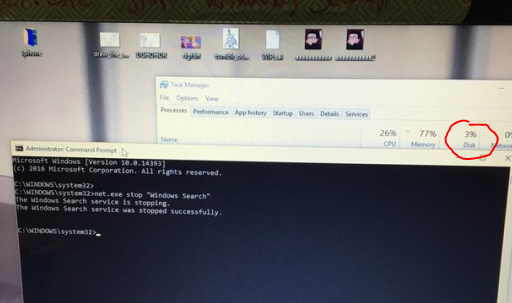
y’all didn’t even add a tutorial of how to do this so imma put one right here
1. type in cmd.exe into your windows search and right click on Command Promt search result and select “Run as Administator”. 2. Type/Copypase in
net.exe stop “Windows Search” and make sure Windows Search is in quotations. It should then respond saying “The Windows Search service is stopping” and then tell you it’s stopped.
This is only a temp fix though, if you want it switched off permanently then do THIS:
1. Press the Windows key + R at the same time and type in services.msc.
2. Scroll until you find Windows Search and double click it to enter its Properties window.
3. Change the Startup type to Disabled. Apply this change and you can exit out.
Likewise, you should stop Superfetch. It’s a service windows has running by default that basically loads up data just in case you happen to need it i guess. Its usually only helpful for video games and it takes up a lot of disk space as well. Open up command prompt like it says above but instead of typing windows search you just type in “net.exe stop superfetch” without the quotation marks. You can also turn it off permanently in services, but it might effect the performance of video games or other data heavy programs.
What is Autistic Burnout?
a guide from Autism Women’s Network
Signs:
• Lack of motivation (hard to care about goals when everyday life is overwhelming)
• Loss of executive functioning abilities (decision-making, organization, etc.)
• Difficulty with self-care
• Easier to reach overload or meltdown
• Loss of speech, selective mutism
• Lethargy, exhaustion
• Illness, digestive issues
• Memory loss
• Inability to maintain masks or use social skills
• Overall seeming “more autistic” or stereotypical
• May have period of high energy before collapse
Causes:
• Passing as neurotypical / suppressing autistic traits
• Doing ‘too much’, too much stress
• Aging: needing more downtime, having less energy
• Changes, good or bad (relationships, jobs, living arrangements, belongings, environment, routines…)
• Sleep deprivation, poor nutrition, dehydration
• Illness
• Sensory or emotional overload
Strategies:
• Time
• Scheduling breaks, managing spoons
• Leave of absence
• Stimming, sensory diet
• Exercise
• Massage
• Reminders and supports
• Routines
• Better environment/job/etc.
• Boundaries, saying ‘no’
• Dropping the mask/façade
• Solitude
• Absolute quiet
• Creative projects, passions, special interests
• Paying attention to reactions and your body
This is a really useful thing, but “American Asperger’s Association” did not write “Help! I seem to be getting more autistic!” Mel Baggs did. It was originally published here. Whoever copied the text onto the American Asperger’s Association forum didn’t bother to give authorship credit.
Okay, so when applying for jobs, you’re generally going to need 4 things: 1) a completed application, 2) your resume, 3) a cover letter, and 4) a list of references. The application you need to do on your own and it’s just filling in boxes, you can handle that. Resumes I’ve already covered! Now, it’s on to the joy absolute gut-wrenching hell that is writing a cover letter.
Good news! You’ve successfully completed all the lower levels of job hunting with your resume, cover letter, and phone interview and now it’s time for the boss battle: the in-person interview. Interviews have a lot riding on them, but you totally got this, because you’re good enough, smart enough, and doggone it, people like you. …but just in case, here are some tips to help you prepare.
fanfic: this character has had several bottles of hard liquor and they’re just slurring their speech slightly and for some reason are not in the hospital with alcohol poisoning
me: ….you’ve literally never had a drink in your life have you
very good point.
Alcohol For the Non-Drinking Fanfic Writer, a primer by me
There’s a shit ton of variability in response to alcohol depending on body mass, history of drinking (your liver can upregulate the CYP450 enzyme responsible for metabolizing alcohol but only to a certain point; chronic alcoholics hit a point where their livers are so trashed they lose this and go back to getting drunk off small amounts of alcohol), and ethnicity (people of East Asian descent are more likely to lack a critical enzyme for breaking down one of the metabolic steps in the degradation of ethanol and are stuck in the shittiest part of it, with flushing and nausea), and other factors.
But if I had to guesstimate for writing:
1 drink (a tall glass of beer, a can of beer, or a shot of hard alcohol in a cocktail or alone): are you a burly dude? you may or may not feel it. are you a tiny lady? you will probably notice it.
2 drinks: burly dude may or may not be noticing it. tiny lady like me: this is a sweet spot where you’re talkative but not drunk. (Note: people don’t go from zero to “so drunk you remember nothing/are profoundly disinhibited.” There’s a lot of ground to cover in between.)
4 drinks: burly dude still feeling it, tiny lady ready to FUCKING FIGHT YOU
5 drinks: burly dude, slow down, buddy, you gonna polish off that six-pack by yourself? That’s going to hurt in the morning. Tiny lady: oh my GOD stop. Go to bed.
This is where we draw the cut-off for a “binge,” if you were wondering. More than this and you’re officially binge-drinking, where your odds of serious harm go up sharply. From alcohol, but also from the bad decision dinosaur that plagues you when you binge-drink.
a fifth of anything by yourself: Sir. Sir, can you hear me? Sir, I need you to open your eyes. Squeeze my fingers. Sir, you’re in the emergency room.
Splitting a bottle of wine between two adults: generally like three drinks each, you’ll feel it but you’ll survive. (A bottle of wine between three adults: usually not quiiiiiite enough.)
An entire bottle of wine by yourself: oh, so you enjoy suffering?
Other Fun Medical Alcohol Facts: high-proof alcohol like vodka will temporarily paralyze your pyloric sphincter, so the alcohol can’t get into your gut for about twenty minutes. Then, when it DOES get into your small intestine, enjoy getting uncomfortably drunk too fast.
Alcohol is a zero-order metabolizer: that means that nothing on Earth can sober you up except time*, and the time it takes is linear, directly related to how much you drank. Most of us can clear about a drink an hour, so if you’re drinking slowly you can stay roughly sober all day. Most of us don’t drink that slowly. Hangovers are made awful by a metabolic intermediate (literal acid in your blood!!!! it’s so shitty!!!!!!!) that makes you nauseated and feel super gross, and not every drinking episode will lead to a hangover, and severity of hangover varies greatly by person and amount drunk.
So please never write someone having coffee to “sober up.“ Now they’re drunk AND they can’t sleep. Bad combo. Sucks for driving. Splashing cold water on your face? No. Amphetamines? Good Lord what’s wrong with you. Look, the room’s gonna spin, you fucked up your endolymph in your semicircular canals, deal with it. You can partially override that with proprioceptive feedback–keeping one foot on the floor to get tactile input–but it’s just gonna suck for a while.
The variability in capacity is real; my aunt-in-law, who is roughly my size, can drink me under the table easily. She’s a high-powered business executive who has martinis with lunch. I tried to keep up with her once and had to call in sick. So you don’t HAVE to write a character having a “normal” alcohol tolerance, but don’t get into “yep, definitely alcohol poisoning” territory, please.
This has been Please Don’t Show Up In My Emergency Room, I Hate Getting Barfed On by your local friendly medical trainee.
*this is technically not true, but no substance you can get your hands on will do it. hmu if you want to hear the story of the EtOH receptor antagonist andwhy it never went to market, what with all the dying.
what’s the EtOH receptor antagonist???
okay whew. here we go. there has been a LOT more interest in this than I was expecting (I was expecting none, to be clear), and it has been approx. 8 billion years since I was in undergrad, which is the last time I can reasonably claim to have been CURRENT on Neuro research. (I did my master’s at an institution that does not have what one might call a robust Neuro department and mainly did Stats.) So if a real live Neuro person comes on here and contradicts me, you should probably believe them.
BUT. Here is the story, as I recall it:
Alcohol, or, as we fancy-schmancy-pantsy medical types like to call it to distinguish it from the bajillion other alcohols out there (”alcohol” describes a general type of molecule in chemistry, not the good ol’-fashioned Get You Drunk molecule) ethanol, abbreviated EtOH, is what’s generally called a “sedative-hypnotic.” What that means is that it doesn’t work on opioid receptors, it doesn’t work on cannabinoid receptors. It does stuff to your GABA receptors–GABA being the major inhibitory neurotransmitter–and it also binds to other stuff. We still don’t have its actions in the brain fully mapped. But we know, and we’ve known for a while, that it does stuff to GABA receptors.
A major pharmaceutical company developed an honest-to-God antagonist. If you’re not a pharm person, you may be going, “a what now?” First point: damn near everything your brain does is determined by neurotransmitters and the receptors that love them. Neurotransmitters interact with their receptors in a variety of ways, with a HUGE variety of end results. Humans love jamming other chemicals that are not neurotransmitters into their receptors. Why do opioids work? Because they mimic NTs we make ourselves. Why does cannabis get us high? Because it mimics endogenous (”originating inside”, self-made) NTs. Manmade molecules that alter us are hijacking built-in systems. Don’t even get me started on how fucking bananas cool it is that neurons can adapt to neurotransmitter levels, and in a super awesome sci-fi-like variety of ways. Take a Neuro class! Take five! Take seventeen! Most fun I ever had was in a Neuro lab.
So what’s an antagonist? It’s something that, one way or another, makes it so the NT can’t do its thing at the receptor.
The line of thinking went, if we can keep ethanol from doing its thing at the GABA receptor, we can make people sober again. They can drink and then take a pill and be sober. Wouldn’t that be AMAZING? Wouldn’t that be lucrative? These are questions that drug companies think about a LOT.
So they made the chemical! Its name is
Ro15-4513. You can Google it and get a WAY less interesting description of what went down. But how my professor explained it to us is like this:
It works. It’s an ethanol antagonist at the GABA receptor. You take it and it blows the ethanol off the receptor and you’re sober. And… because humans are awful, you get drunk again. You take another pill. You’re sober again. The time that pill is active is less than the time it takes your body to metabolize ethanol, so you’ve still got all that ethanol swishing around in your system waiting to murder you via aspirating your own vomit the hot second it wears off, but by God, you’re sober.
Except, as mentioned, the GABA receptor is not the only place where ethanol does stuff. One of the effects it has, since it’s such a teeny tiny molecule, is fucking with the lipid bilayer that forms the bulk of your cell membrane. If you’re a Neuro person, you’re getting cold chills right about now, because the only reason neurotransmission works is the properties of the lipid bilayer. You have to be able to transmit electricity down the axon of the neuron to generate an action potential. The lipid bilayer is what allows you to do that.
The pill does nothing for that. So if you take enough of the pill, and keep drinking, there comes a point where you’ve fucked the lipid bilayer beyond repair. You can’t transmit messages. Your brain doesn’t remember how to tell your body to do things like breathe, or not have seizures. And you die!
So, in summary, we have a pill that could make you a responsible designated driver, but actually fucking kills you because people have no self-control.
Moral of the story: Neuroscience Is Super Fun!!!!! It was my gateway drug into medicine. I would never have gone to medical school if it weren’t for my Behavioral Neuroscience professors.
today on: humanity’s hubris has led to so many things being bad when they were designed to be good


 tora42's nonsensne