sartorialadventure:

cestriankiwi:

josef-tribbiani:

bigwordsandsharpedges:

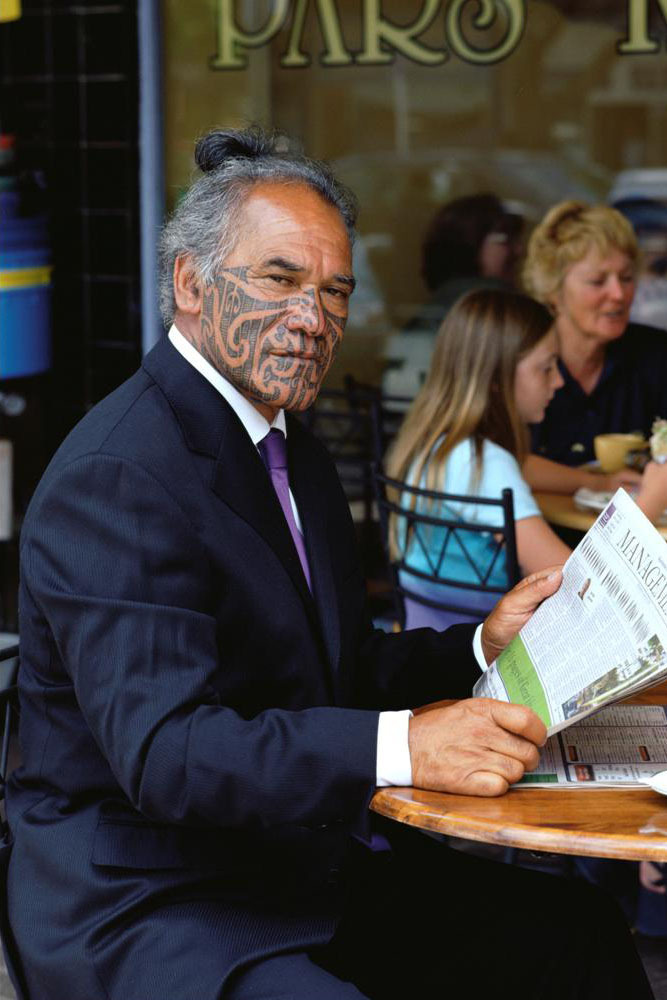
The native Maori people of New Zealand have tattooed their faces for centuries. They had a complex warrior culture before the arrival of Europeans, and suffered under early colonialism, but have experienced a cultural revival since the 60′s. 

The marks are called moko, and are etched with chisels instead of needles to leave grooves along with the ink. The true form is sacred, unique to each person, and distinct from European tattoos that mimic that traditional style.

There arent many pictures non combat related that look this badass

Actually most
Tā moko are done with modern tattoo equipment these days, but some people get them done the traditional way. And, as others have said, they’re not for Non-
Māori, as they have specific meanings and significance. If you want a tattoo with Māori

style, you can get a
kirituhi. These avoid any designs associated with particular tribes or famous people you’re not related to.

Kirituhi is a Māori style tattoo either made by a non-Māori tattooer, or made for a non-Māori wearer. Kirituhi has mana of it’s own and is a design telling the unique story of the wearer in the visual language of Māori art and design. Kiri means ‘skin’, and tuhi means ‘to write, draw, record, adorn or decorate with painting’.

Kirituhi is not restricted to only Māori people, and it is a way for Māori to share our cultural arts with people from around the world in a respectful manner, and for non-Māori artists to enjoy our beautiful art form as well. I happily do kirituhi for my clients around the world and it is a privilege to do such work for them.

Kirituhi is no lesser an artform than moko, however it is different and I believe these differences must be acknowledged and respected, so that the integrity of our taonga Māori – moko, is maintained around the world.

Moko is uniquely Māori and it is strictly reserved to be done by Māori, for Māori.

If either the recipient or tattooer do not have Māori whakapapa, then the resulting design is a Māori Style tattoo or kirituhi, NOT moko. The word moko originated from the Māori atua (god) of volcanic activity and earthquakes, Rūaumoko – therefore the origin of tā moko is divine and sacred – to me this is no small thing, nor should it be dismissed.

As my mentor once told me, ‘moko is about 99% culture, and 1% tattoo’.

(source)

In narrative therapy, Māori creation stories are being used to heal

coldalbion:

The boy sits there, his head down. He feels stink; he knows all the adults are there to talk about him, about what’s wrong with him.

He’s always been told off for being so fidgety, for not paying attention. He knows it’s a bad thing.

But when the talking begins, it’s not about how to fix him. They’re telling a story about atua, the gods, and one of them sounds exactly like him! He’s called Uepoto, and he’s always curious. He’s full a mischief, a tutū.

The boy looks up.

“That’s where the healing starts, with an exchange of words,” says Poutu Puketapu, 25, a mental health worker at Gisborne service Te Kūwatawata. Only, that’s not his title here – in this space he’s a Mataora, or change-maker.

And the boy isn’t a patient, or client, or even a consumer. He is simply whānau.

“Instead of labelling them and making them feel like they are part of the mental health system, we reach them with these narratives. When they hear the pūrākau (stories) you see a little spark in them.”

Mahi a Atua is a form of narrative therapy that focuses on recovery from the trauma of colonisation. Māori creation stories are used as a form of healing, connecting alienated Māori to their whakapapa.

The pilot programme began in August last year as a response to the disproportionate mental health issues among Māori, and is backed by the Ministry of Health’s innovation fund and Hauora Tairāwhiti District Health Board.

Māori youth are two-and-a-half times more likely than non-Māori to commit suicide. Māori in general are more often underdiagnosed, and once in the mental health system are more likely to be secluded and imprisoned.

Mahi a Atua is driven by Dr Diana Kopua, an Otago University Māori health academic and clinician who is Head of Psychiatry at the DHB, and her husband Mark Kopua, a tohunga and Tā Moko practitioner.

We, as colonizers, have spent generations engaging in a project of destruction and suppression of indigenous languages and stories. We have dismissed them as mere superstition, instead of highly conserved forms of identity and epistemology. Indigenous knowledge of identity, local flora, fauna, and the Deep Time of the landscape, narratives of self-and-Other providing insight into complex ecological relationships – all these are beginning to be (grudgingly) acknowledged as not only useful, but in some sense ‘necessary’ for wellbeing.

The mythopoetic arises from gnosis – the point of contact between living environment and humanity. For indigenous peoples, I suspect the gnostic interplay stretches for hundreds if not thousands of years – or at least would have, had we not, as colonizers, attempted to break and shatter those links which ran throughout Deep Time in an effort to reduce those peoples in service to capital and authoritarianism.

Ironically, we have even had these weapons turned back upon ourselves – the colonizing peoples having their own localised and highly specific forms of knowledge destroyed or dismissed unless their narrative power could be made to serve State or Corporate Imperialism.

To quote Ursula K. Le Guin: “A writer is a person who cares what words mean, what they say, how they say it. Writers know words are their way towards truth and freedom, and so they use them with care, with thought, with fear, with delight. By using words well they strengthen their souls. Story-tellers and poets spend their lives learning that skill and art of using words well. And their words make the souls of their readers stronger, brighter, deeper.”

Long live the tales of the Maori – and their tellers!

In narrative therapy, Māori creation stories are being used to heal