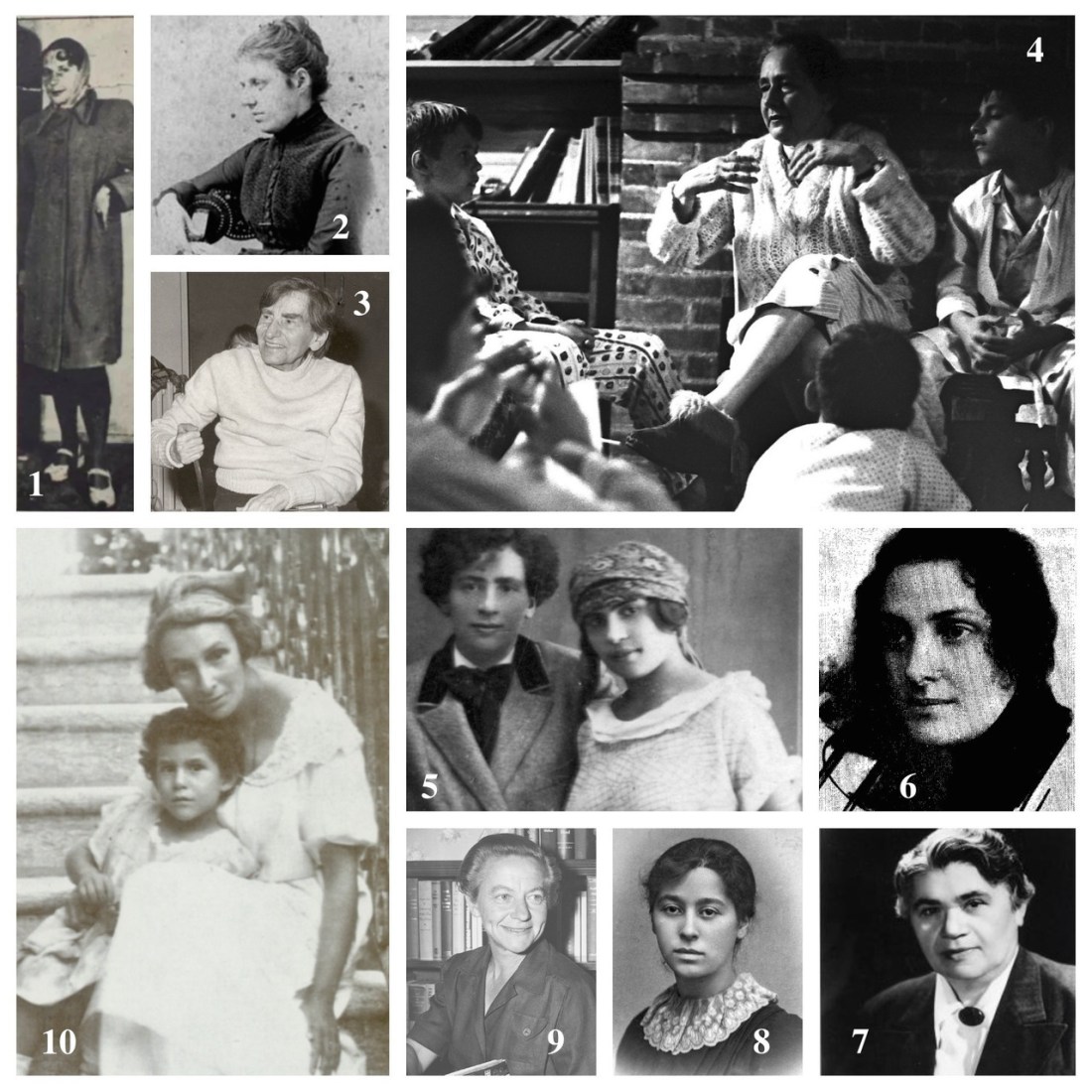
10 LGBTQ Jewish Women from History You Should Know
Another sneak preview from my anthology, in honour of International Women’s Day! Preorders will be coming soon: to sign up, go to the Print-O-Craft website! And of course this isn’t a comprehensive list… These are just entries for which I happen to have photographs (and so it’s very 20th-century heavy, and Ashkenazi-heavy — but trust me, there’s more in the book!).
Clockwise, from top left:
1. Rina Natan (b. 1923). The first trans woman known to have transitioned in Israel. Born in Germany, she made aliya in 1946, and began advocating for her case for transition in 1953, inspired by Christine Jorgensen. She finally underwent sex affirmation surgery at Assaf Harofeh Medical Center in 1956 and received a new te’udat zehut [identity card], but continued to face discrimination and suspicion. In 1958 she left Israel for Switzerland; further details of her life are unknown.
2. Emma Lazarus (1849-1887). Born to a prominent American Portuguese-Sephardi family, Lazarus is most well known for her poem, “The New Colossus,” written in 1883 and inscribed on the base of the Statue of Liberty in 1903. In several of her other published and unpublished poems, Lazarus openly expressed a yearning desire for emotional and erotic connection with other women, but nothing is known about her own sexual or romantic life; Lazarus died of Hodgkin’s disease at the age of 38.
3. Charlotte Wolff (1897-1986). A German Jewish physician, psychologist, and sexologist. In 1933 she fled Nazi Germany to Paris, and then to London, where she lived the rest of her life (with a brief return to Germany in the late 1970s). Her first publications dealt with cheirology (the study of the hand), but in the late 60s she turned to the study of sexuality, and began a series of in-depth interviews with lesbians and bisexual women that resulted in her groundbreaking study Love Between Women (1971), followed by Bisexuality (1977).
4. Vera Lachmann (1904-1985). A renowned classicist, poet, and teacher. Born in Berlin, she graduated from the University of Berlin in 1931; in 1933, she opened a school in Berlin for Jewish children, and maintained it until the Nazis closed it in 1939. Lachmann managed to escape Germany in November 1939 to the US, and taught at Vassar, Bryn Mawr, Yale, and finally Brooklyn College, until her retirement in 1974. She also founded a boys’ educational summer camp, Camp Catawba, in the Blue Ridge Mountains of North Carolina; Lachmann directed the camp until its closing in 1970. In 1950, Lachmann met the woman who would become her lifelong partner: American composer Tui St. George Tucker (1924-2004), to whom Lachmann dedicated her 1969 book of poetry, Golden Tanzt das Licht im Glas [Golden Dances the Light in the Glass].
5. Eve Adams (1891-1943). Born Ewa Zloczewer, in Mława, Poland. Immigrating to the United States in 1912, she moved to New York and opened a tearoom in Greenwich Village, referred to as Eve’s Hangout. It was raided in 1926, and an undercover female police officer confiscated a pioneering book Adams wrote (under the name Evelyn Addams) titled Lesbian Love. For publishing an “obscene” book, and for allegedly flirting with the policewoman, Adams served a year and a half in prison; since Adams was not a US citizen, she was then deported back to Europe. She settled in Paris, where she befriended (and sold the books of) a number of local and visiting literati, including Henry Miller and Anaïs Nin. After the Nazi invasion of France, Adams fled to Nice, but was deported to Auschwitz on December 17, 1943, and murdered there.
6. Dine Libkes (b. 1900). The pen name of Dine Kipnis-Shapiro, born in the Ukrainian shtetl of Slovechno in 1900. Libkes moved to Kiev as a young woman and published a number of stories, poems, and translations there; a number of her poems were republished in Ezra Korman’s Yiddish anthology of women’s poetry, Yidishe Dikhterins Antologye (Chicago, 1928). Her poetry speaks of longings and sensual desires for other women, although without explicit eroticism. Libkes apparently survived WWII in Central Asia, and returned to Kiev after the war.
7. Pearl Hart (1890-1975). One of the leaders of Mattachine Midwest, the Chicago chapter of the national homophile activist organization. Hart was born in Michigan, and raised in Chicago; her father, a Russian-born rabbi named David Harchovsky, served a congregation on the Near West Side. One of the first female attorneys to specialize in criminal law, she was admitted to the Illinois Bar in 1914, and practiced law for 61 years, working until just weeks before her death. A founding member of the National Lawyers Guild, and the American Committee for the Protection of the Foreign Born, she devoted her life to fighting for the rights of the vulnerable and oppressed, especially women, children, immigrants, and gay men and lesbians. She herself had two long-term female partners — singer/actress Blossom Churan, and activist/writer Valorie Taylor — but Hart never publicly identified as a lesbian; she portrayed her involvement with Mattachine as that of a professional legal advisor.
8. Amy Levy (1861-1889). A pioneering novelist and poet, born in London to an acculturated, upper middle class Anglo-Sephardi family. She received an excellent education, and was the first Jewish woman to be admitted to Newnham College of Cambridge University. Her first volume of poetry, Xantippe and Other Verse, was published in 1881, and over the next decade she published two more poetry collections, three novels, and many articles. She travelled throughout Europe, and in Florence met and fell in love with Vernon Lee (Violet Paget), a British lesbian writer and essayist, to whom she dedicated several love poems. Levy struggled all her life with depression, and with alienation as a woman and a Jew; she committed suicide in 1889, just before her 28th birthday. Oscar Wilde eulogized her, saying, “to write thus at six-and-twenty is given to very few… The world must forego the full fruition of her power.”
9. Jo Sinclair (Ruth Seid, 1913-1995). Award-winning leftist American writer, born in Brooklyn to parents who had fled pogroms in Russia. Her first published novel, Wasteland (1946), is a landmark both of Jewish-American literature and LGBTQ literature. The novel focuses on Jake Braunowitz (who also goes by John Brown), an American Jew struggling with his Jewish identity, and his sister Debby, who is both a committed Jew and a lesbian, although she never uses that word for herself — the closest Debby comes to naming herself is when when she tells Jake, “the odd ones, the queer and different ones. They were people. I was people… I was them.” Jonathan Ned Katz described Debby as “probably the most complex, human, and affirmative portrait of a homosexual (male or female) to appear in American fiction” until the 1960s. Seid herself was generally quiet about her lesbian identity, although she did discuss it more freely in letters from the 80s and 90s. She published a memoir in 1993, The Seasons, and spent her last years with her partner, Joan Sofer, in Pennsylvania.
10. Jessie Sampter (1883-1938). American Zionist writer, poet, and educator. Born in New York City to an assimilated, middle-class German-Jewish family, at the age of 12 she contracted polio, and lived for the rest of her life with chronic pain, muscle weakness, and limited mobility. Drawn to Zionism, Sampter moved to Mandate Palestine in 1919, and published dozens of books, essays, and educational materials about Zionism. Soon after her arrival she met a Russian immigrant named Leah Berlin, and the two of them lived together, along with a Yemenite orphan that Sampter adopted, for almost all the remainder of her life. Her recollections connect her disability and her own erotic desires through the complexity of her embodied experience.
 tora42's nonsensne