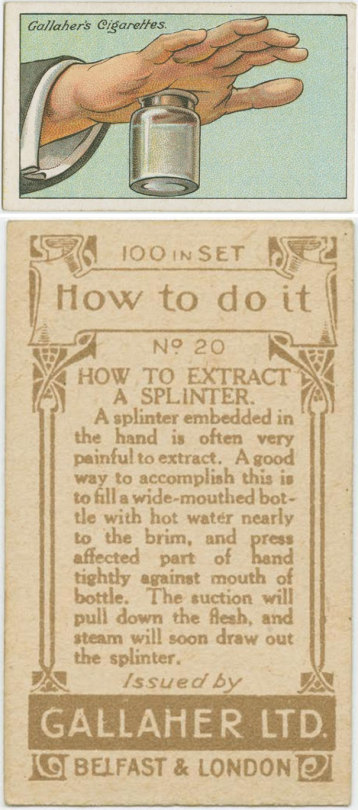
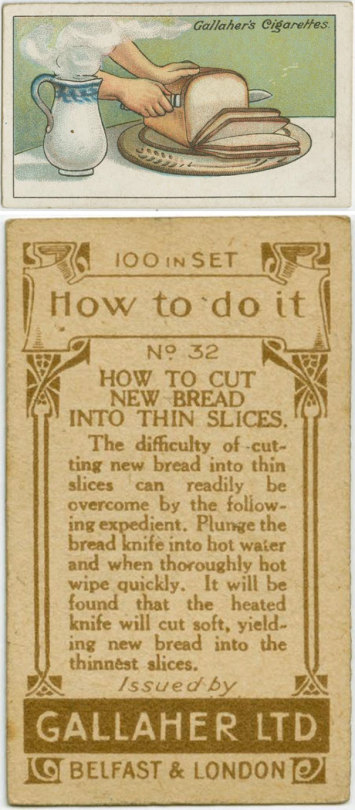
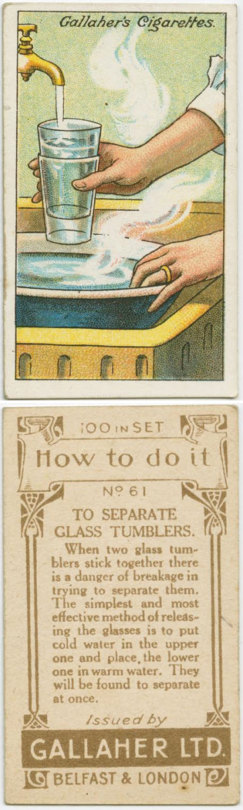
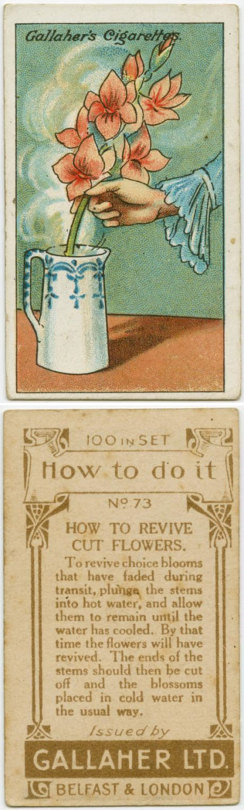
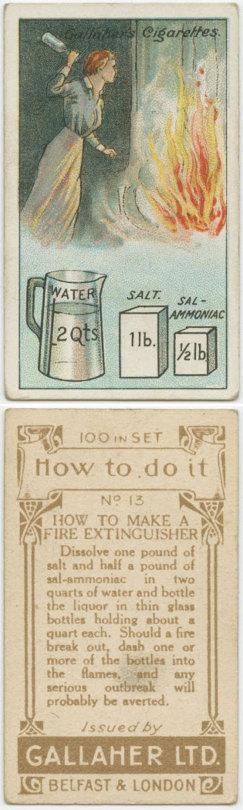
People don’t often look back on the early 1900’s for advice, but what if we could actually learn something from the Lost Generation? The New York Public Library has digitized 100 “how to do it” cards found in cigarette boxes over 100 years ago, and the tips they give are so practical that millennials reading this might want to take notes.
Back in the day, cigarette cards were popular collectibles included in every pack, and displayed photos of celebrities, advertisements, and more. Gallaher cigarettes, a UK-founded tobacco company that was once the largest in the world, decided to print a series of helpful how-to’s on their cards, which ranged from mundane tasks (boiling potatoes) to unlikely scenarios (stopping a runaway horse). Most of them are insanely clever, though, like how to make a fire extinguisher at home. Who even knew you could do that?
The entire set of life hacks is now part of the NYPL’s George Arents Collection. Check out some of the cleverest ones we could find below. You never know when you’ll have to clean real lace!
why caffeine works for some of us, but not all, and even then it often depends on the way you take it and the dosage
how come all of us have gastrointestinal problems?
addendum to the above: what exactly are our gastrointestinal problems? are we genetically more likely to have autism be comorbid with gluten sensitivity/colitis/IBS/lactose intolerance/whatever else or is it something completely different? is it psychosomatic? the fuck
okay but how does being sensory-seeking work. and what does stimming do to your brain. what neurological function are we facilitating with flapping hands and rocking back and forth and spinning? wouldn’t it be great if we had a serious long-term study of the brain on stimming?
are you more likely to be autistic and LGBT?
what are things we do better than neurotypicals?
but no it’s always “how do we train the animals to be something they’re not” or “but what made you this way??” or “Time To Find A Cure”
why do we all have sleep disorders
what’s up with the joint problems
and the faceblindness
what are the communication patterns here? how come I can meet one autistic person and immediately grok how they communicate, and be confused by another, but all neurotypicals are confusing? what’s going on with that?
how much of what we currently recognise as ‘autistic symptoms’ are actually ptsd symptoms? or autistic ptsd symptoms?
ALL. OF. THIS.
OK, so I decided to check out which of these had been researched and what they found.
Caffeine – not much, but this study looks interesting. It suggests that if you’re not a regular caffeine consumer, caffeine might temporarily make you act less autistic.
Oh, hey, this study has a potential answer to both caffeine response and sleep problems! There’s apparently an enzyme that affects both caffeine and melatonin metabolism.
GI issues – this study didn’t find a link. The rate of GI issues was 9% for both autistic and NT children. The most common GI issues for both groups were food intolerance, usually lactose intolerance.
This study found a much higher prevalence of GI issues in autistic kids (17%), although they didn’t compare them with NTs. They also suggest that there may be a link between regression and GI issues, and confirm yet again that the MMR vaccine has nothing to do with autism. The most common GI issue they found was constipation, followed by diarrhea and food allergies.
This study compared GI issues between autistic kids and NT siblings. They found that 83% of the autistic sample and 28% of their siblings had at least one possibly-GI-related symptom. They also give data on specific GI symptoms, such as gaseousness (54% of autistics and 19% of siblings), abdominal discomfort (44% of autistics and 9% of siblings), and so forth. They found 20% of autistics and 2% of siblings had three or more poops per day, 32% of autistics and 2% of siblings had consistently watery poops, and 23% of autistics and none of their siblings had large changes in consistency. Also, apparently parents felt that 49% of the autistics and none of the siblings had particularly foul-smelling poops. And another for the sleep question – this study found 51% of autistics and 7% of siblings had sleep problems, with sleep problems being more common in autistic kids with GI issues.
Stimming and Sensory-Seeking – I couldn’t find much. This study I found is interesting, but it’s about more OCD-like compulsions, not actually stimming.
Oh, here’s something. A big detailed review of neurophysiological findings of sensory processing in autism.
LGBT – I’ve written up stuff about this elsewhere, but in short, autistic people, especially AFAB autistics, are definitely more likely to be asexual, bisexual, kinky and trans. Some relevant studies here, here, here, here, here, here, and here, and there’s plenty more to be found.
Autistic Strengths – Well, Laurent Mottron and his team, including autistic rights advocate Michelle Dawson, have done a lot of research on what they term ‘enhanced perceptual functioning’, which they theorize explains the Block Design peak sometimes seen in autistic people. (Block Design is one of the subtests of the Weschler’s IQ test, and autistic people often show a relative strength on this test relative to other subtests on this test.) In general, I highly recommend looking at their research. It really shows what can happen when an autistic person gets involved in autism research.
This study by a different research team finds that children gifted in realistic still-life drawing have higher rates of repetitive behavior typical of autism (though none of their sample were actually autistic), and show similar visuospatial profiles to autistic kids.
This study finds that perfect pitch is associated with autistic traits. On the AQ, musicians with perfect pitch scored higher on the imagination and attention-switching subscales than musicians without perfect pitch and non-musicians. This study found a subset of autistic kids have extremely good pitch perception, with no relationship to musical training.
People in STEM fields are more likely to be autistic or have autistic relatives, especially mathematicians. (Which probably comes as no surprise to anyone who’s spent time in the math department of any university.) This study also finds that autistic kids tend to be better at math.
Sleep – as a couple studies above mentioned, sleep issues in autism could be related to melatonin metabolism or GI issues. This study found that 53% of autistic kids, 46% of kids with intellectual disabilities and 32% of NT kids have sleep problems. Autistic kids are both slower to fall asleep and more likely to wake up early than NT kids.
This study found a correlation between autistic traits and sleep problems in autistic kids. Repetitive behavior is related with being slower to get to sleep and not getting as many hours of sleep per night; communication problems are related to being slower to get to sleep, not getting as much sleep, and parasomnias (night terrors, restless leg syndrome, etc); and social differences are related to being slower to get to sleep, not getting as much sleep, waking up at night, parasomnias and breathing problems while sleeping.
This study found a strong correlation between sleep problems and sensory hypersensitivity among autistic kids. And this study found that autistic and/or intellectually disabled kids showed strong correlations between poor sleep, anxiety and behavior problems.
And this study found that 67.9% of autistic kids have sleep problems, and parents of kids with sleep problems were under more stress. Boys and younger children had more sleep problems.
Joint problems – This study found that people with Ehlers-Danlos Syndrome, a connective tissue disorder that causes joint hypermobility, were more likely to be autistic. (And also to have mood disorders and attempt suicide.)
This study suggests that people with joint hypermobility have larger amygdala and various other brain structural differences, which was correlated with anxiety and higher sensitivity to internal body sensations. And this study found that 31.5% of people with ADHD and 13.9% of NTs have benign joint hypermobility syndrome.
Faceblindness – This study confirms that prosopagnosia (faceblindness) is more common among autistic people, with 67% having some degree of facial recognition difficulties.
This study reviews three theories about why autistic people have prosopagnosia, and concludes that the most likely of the three theories is the idea that avoiding eye contact impairs face recognition.
This study found that autistic people are slower to notice faces in scenes, and pay less attention to faces.
The last two questions I’m not really sure where to start.
I’m just gonna keep saying this because I get asked this periodically and really thought I had this in my FAQ:
Slaves did not build the Pyramids. That is a misconception first put forward by Herodotus – who claimed Khufu kidnapped 100,000 people to work on the Pyramids (he also claimed Khufu whored out his daughter…but Khufu didn’t have a daughter), and then Hollywood combined it with the Exodus story where the Jewish folk were enslaved by Pharaoh to create the myth that slaves built the Pyramids. It’s not feasible that 100,000 people would be simultaneously enslaved and working on the Pyramids at the same time. Where are you keeping them for a start? How do you even police 100,000 enslaved people in one location? How do you stop them just getting in a boat at night and sailing up the Nile to freedom?
Who did build the Pyramids?
Officials were sent out to all parts of Egypt to ask various single men to join the effort to build Pharaoh’s Pyramid (easier not to have families if you’re leaving for 20 years). This was considered an honour because Pharaoh was a literal god at this point in Egyptian history. Work for the god on his project? Excellent.
So the guys travelled to the Giza plateau and began building the Pyramid. Quarrying stone from the nearby limestone quarries, or quarrying it near the Red Sea and transporting it via canals to Giza. The workers were paid in bread and beer. Egypt was a non monetary economy, which means they don’t have coins so they barter with various commodities. Food is payment. They didn’t really ‘receive’ this payment in bulk form, what would happen is that they would be fed by the women who also came to the Pyramid building site. These folks lived in what we now know as the Giza Workers Village which held about 20,000 people (only 5000 were permanent salaried workers, the other 15,000 were seasonal and different workers turned up every year). Men would meet women while working there and they’d settle down and have a family who also lived in the village. We have their graves that show us that ailments were well looked after by an onsite doctor and not just hastily repaired or not allowed to heal. More on this can be found here, here, here, and here.
Finally, were the guys who built the Pyramids were divided into two groups who liked to graffiti their group names onto the insides of the Pyramids: One – the Friends of Menkaure, and Two – The Drunkards of Khufu. Here’s the graffiti:
Slaves don’t generally call their gang ‘drunkards of Khufu’. That name is more ‘stag night in Magaluf’ than ‘enslaved by Pharaoh for 20 years’ so I’d say they were proud of their work.
Hold it! Hold the phone. Now give the phone to me. Okay. You cannot just casually drop the fact that the builders of the big Pyramids divided themselves into gangs and graffiti’d cartouches into the damn pyramids and then not elaborate further. I have SO MANY QUESTIONS RIGHT NOW! Who is Menkaure and why are we their friends? Why are we getting drunk for Khufu? Did they really write graffiti in actual hieroglyphics instead of an easier script like hieratic or demotic? What did they graffiti with, and how is the graffiti still around? Why two factions? How did they get divided in the first place? What’s the difference between them? How long did this feud last? Did it get violent or were they just competitive about stuff? Was there a Field Day for pyramid workers where the Friends and the Drunkards would compete in, like, the Egyptian equivalent of a sack race?
I need answers.
I’m not an actual egyptologist like OP, but I can answer some of this.
First of all, gangs refers to work gangs and these would have been assigned by those in charge of the project, not casual/crime gangs thankfully.
Menkaure was the pharaoh for whom the final, smallest (of the main three) pyramids was built, and as OP said, the pharoah was considered a divine figure and being his pal? Good press. And since these were craftsmen building his grand final resting place in the most modern, cutting edge architectural style, I’d imagine they were pretty favoured by the king for real, and not just by name.
Khufu was the pharoah for whom the first and largest pyramid was constructed – its worth noting that the middle pyramid, belonging to Khafre was built on a slight mound and with steeper sides to make it look bigger than Khufu’s when the complex is viewed from afar. It’s not though. Nice try Khafre. I’m not completely sure of the Drunkard element, but I have to imagine it was some kind of honouring of the king (or his soul) or celebratory thing, as several festivals to gods and ancestors involved getting totally shitfaced.
The graffiti to my knowledge is mostly carved in inaccessible locations, such as the insides of the concealed structural support chambers above the bural chamber proper, and hidden air/construction shafts. It very much seems to be a “we made this, remember us” type deal, not dissimilar to the masons marks you see on old stone buildings in the west. From OPs pic they may have also used paint, unless that was a modern addition to outline very faint markings in the stone?
Having your name remembered by your descendents was a big deal in the ancient egyptian religion, and this may have been related to that. Or indeed, just “Hey, the king gets a whole pyramid, we can have a little etching can’t we?”. The names of the artists, scribes and craftsmen who created the paintings, engravings and statuary of the time almost never had their names recorded on it. You think people are bad at crediting artists nowadays?? Of course some prominent craftsmen got their own tombs, and the architect Imhotep got to be an entire God (good for him), but credit for specific pieces wasn’t really a thing. These workers apparently had other ideas. (Good for them. Well. Collectively at least.).
OP is definitely the language expert, but I do know the pyramids predate Demotic by a good couple of millenia. Hieroglyphs may be due to media, or formality?
I think it’d be better to think of the gangs as like an A Team and B Team on a modern construction project. There was almost certainly rivalry there, but in the end they were both getting paid (in a sense) to do the same job, just different tasks.
Thanks @severalowls! Great explanation! And yes that graffiti is original. It’s done with the paint that would have been used to mark up where things go during the building process.
Just to clarify the hieroglyphs question for @sundayswiththeilluminati: You’re right, the pyramids predate demotic by a good 3000ish years. There are also rules about when certain scripts are used and on what medium. Hieratic is almost exclusively used on papyrus as it is the shorthand form of the script. Hieroglyphs are used on monuments and tombs because they’re clearer. Writing the Kings name in hieratic without the proper honorifics? Really bad. In hieroglyphs you can give him the proper honour he deserves. It’s also debatable whether these guys would have known hieratic. They’re not trained scribes after all.
Robert Johnson, or at least the mythical version of him, is pervasive in American pop culture. He is considered a “Faustian” character, which essentially means the story surrounding him involves making a deal with
himself. Deals like these typically were said to take place at crossroads, often seen as a metaphorical or actual liminal space, a place where change happens.
The legend goes that Johnson fell distraught after his first wife died in childbirth and he turned to his love of music to cope but he was horrible at the guitar with an unpleasant voice. Johnson was said to have disappeared for a length of time and then returned with great musical skill and a wonderful, mournful singing voice. At a crossroads, marked with the three guitar statue (above), Johnson supposedly met a man who gave him these abilities–in return for his soul. People point to some of his songs like “Cross Road Blues” and “Hell Hound on My Trail” as evidence that he had made the deal with the devil and the hellhounds were there to collect.
Johnson only recorded three records and died at the age of 27 in 1938 due to “mysterious” stomach pains. Of course, the legend would have us believe that the Devil had come to collect his dues. Most people, however, believe that he was poisoned (one way or another) due to flirting with or having an affair with a married woman. Either way, he died very young after putting out only a little bit of music and had only a couple of photos ever taken of him. He’s a figure shrouded in mystery due to how little is known about him but he lives on in our collective imagination, still recognized as the King of the Delta Blues.
Particularly for those who were kind enough to participate in our survey last week, or to share it even after we halted data collection (because we received so many responses so quickly!), I wanted to give you something interesting right away. As you know, the academic writing and publishing process can be lengthy, so who knows when you might get a full paper from us! But in the meantime, this was the analysis I did this weekend.
The survey asked for participants to indicate what platforms they use/used from a given list, and also to indicate a date range (e.g., Tumblr 2006-2018). I parsed those date ranges in order to determine for a given platform how many of our participants were active in a given year. (This actually gave me an excuse to write some code for the first time in years. Jupyter Notebooks are super cool.)
(Click on the image above for full resolution!)
The Y axis is number of survey participants who indicated using the platform during a given time, and the X axis is year. (This starts at 1990, though I’ll note there were 10-ish participants who indicated using usenet, email lists, and/or messageboards in the 1980s.)
Some interesting things to note: (1) See how fanfiction.net has a spike where there was a big drop off but then it stabilized? That’s around the time that they cracked down on adult content. (2) I expected to see Livejournal decline drastically sooner, but it actually continued to climb a bit after Strikethrough and related things, until Tumblr and AO3 both started getting very popular. Based on what I’ve seen qualitatively so far, I do think that people were starting to leave, but that there had to be critical mass elsewhere in order for that leaving to start going en masse. There were also a lot of people who continued using Livejournal while they picked up other platforms as well. (3) As my PhD student collaborator Brianna said, we have “a beautiful arc of AO3 and Tumblr being besties forever.” (This makes sense to me based on some findings from my previous work about AO3, and how Tumblr filled in the gap of social interaction left by Livejournal.)
In the “other” category of fan platforms used, the most popular was Discord. This doesn’t surprise me! For the most part, participants had only been active in it for the past couple of years, which is why it didn’t show up specifically in the survey (which was constructed based on interview data we already had). We also saw less frequent mentions of Facebook, reddit, delicious/pinboard, and IRC.
Digging into the qualitative data will give this data much more explanatory power, but I think this is very interesting!
We also asked participants what their primary fandom was for each platform they used. Based on a pretty simple analysis (most popular words!), here are the top five fandoms from each platform:
Usenet: Star Trek, Buffy, X-Files, Star Wars, Sailor Moon
Email Lists: Harry Potter, Star Trek, Buffy, X-Files, Gundam Wing
Messageboards: Harry Potter, Buffy, Star Wars, Lord of the Rings, Sailor Moon
Fandom-Specific Archives: Harry Potter, Buffy, Stargate, X-Files, Doctor Who
Fanfiction.net: Harry Potter, Naruto, Buffy, Star Wars, Gundam Wing
Livejournal: Harry Potter, Supernatural, Stargate, Doctor Who, Merlin
DeviantArt: Harry Potter, Naruto, Kingdom Hearts, Supernatural, Final Fantasy
Dreamwidth: Harry Potter, Supernatural, Marvel, Stargate, RPF
Archive of Our Own: Marvel, Star Wars, Harry Potter, Supernatural, Teen Wolf
Tumblr: Marvel, Star Wars, Supernatural, Harry Potter, Teen Wolf
Twitter: Star Wars, Supernatural, Marvel, RPF, Yuri on Ice
Note that this is NOT necessarily representative of the overall popularity of certain fandoms on these platforms. Our survey, because it was targeting research questions about fandom migration, asked for participants who had been in fandom for 10+ years. This means that our results skewed older (mean 31; median 30; SD 8.6). And of course, most of the participants are currently in fandom, which means that it also misses people who have left fandom.
It is interesting to see the change across platforms and over time though! My favorite tidbit is how Star Wars was popular, dropped off, and then came back with gusto.
This is only the tip of the iceberg on this data analysis! If there’s anything else that is easily shared as we do this analysis, I’ll continue to do so. Otherwise, wish us luck and I’ll eventually share a completed analysis if/when (fingers crossed!) we publish on this.
I have a list of emails from everyone who participated and wanted to give us that info to share the results. If you’d like to be added to that list, send me an email at casey.fiesler@colorado.edu. Or just feel free to follow me here, or myself and Brianna on Twitter.

 tora42's nonsensne