honestly fuck viruses they’re not even alive they’re just strands of punk ass DNA that go around fucking up us normal and god fearing life forms you don’t even have a nucleus you stupid bacteriophage looking horizontally transmitting RNA clump
Excuse you the VAST MAJORITY of lifeforms don’t have nuclei this is PROKARYOTE ERASURE and you are lucky cyanobacteria don’t just TAKE ALL THEIR OXYGEN AND GO HOME
Peter Parker: -on meeting Loki, offers his hand- Hi, I’m Peter!
Loki: -shakes his hand- Loki of Asgard.
Peter: Aren’t you like…a bad guy?
Loki: It varies from moment to moment.
Peter: So like…on a scale of one to ten, ten being the worst evil imaginable, like…killing puppies, and one being I’ll spit on your hotdog…where are you right now?
Loki: …maybe a three?
Peter: Cool. Lemme know if it gets above a six.
Loki: -thinking- I like him.
It had been a joke, a flippant line, but somehow, Loki found himself taking the youth up on it.
It was hard living around these heroic Avengers, hard trying to stay close to Thor. And when he felt his need for mischief rise too high, when he felt exasperation with these Midgardians turn too close to spite, he would casually say “Six.” to the young man, or sometimes “Seven.”
And Peter would spend the rest of his day with Loki. He would badger him with questions about magic, or drag him across his beloved city to see its entertainments, or take him along stopping petty crimes. He grounded Loki to the here and now, and distracted him from the churning, jagged shards of ice in his mind.
hi-ho, bunjy here! it’s time for another installment of Weird Biology, and today I’m going to introduce you to a creature that looks like it flopped awkwardly out of a Lisa Frank concept art book.
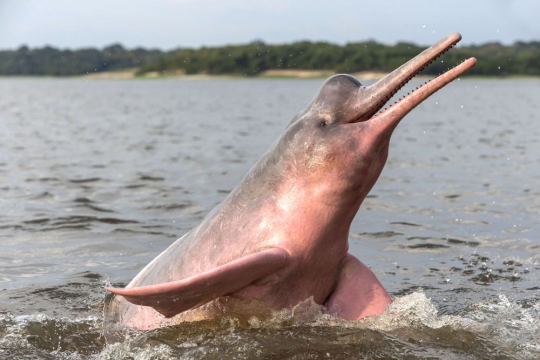
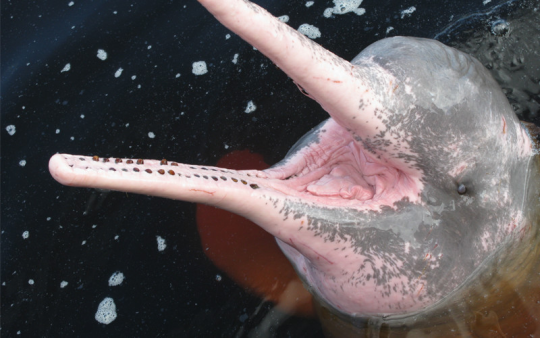
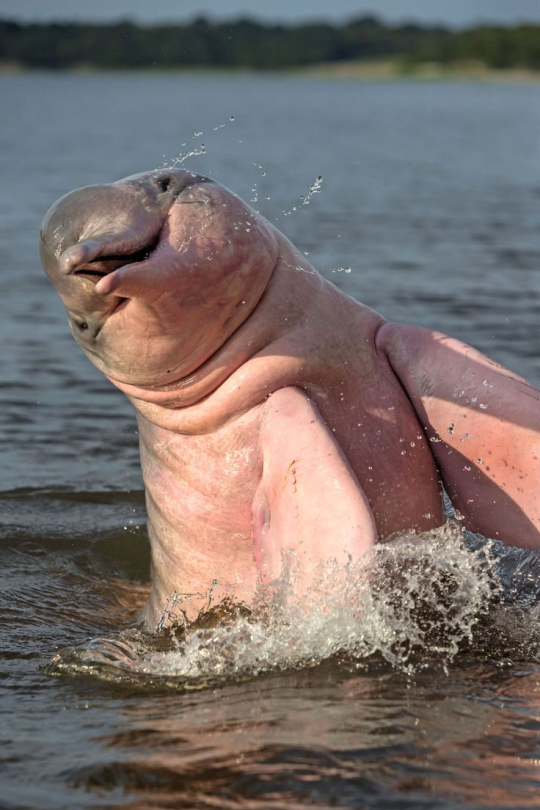
meet the Amazonian River Dolphin, or Boto!
he’s Boto’ mess you up if you don’t stop laughing
Botos are the world’s most numerous river dolphin. (yes, river dolphins are totally a thing. weird, right?) they flop around obnoxiously in rivers throughout much of South America, though most of them live in or around the Amazon basin.
they are also the word’s largest river dolphin, with males reaching lengths of well over eight feet and weights of over 400 pounds, which places them firmly in the category of “animal I would not fistfight under any circumstances”
they don’t even have fists and I still wouldn’t
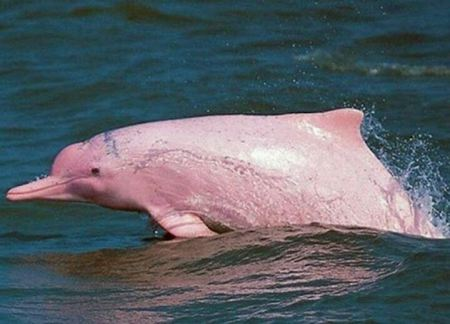
the Boto is also a variation of pink colloquially referred to as Rubbery Bubblegum Blast by scientists (or it will be, as soon as I can locate those scientists. they’re tricky bastards).
surprisingly, the Boto actually starts life grey and transitions to pink as it gets older and scrapes itself up a bunch by running into things and getting into slapfights with other dolphins.
yes, that’s actually why. I still think it looks like a barbie accessory
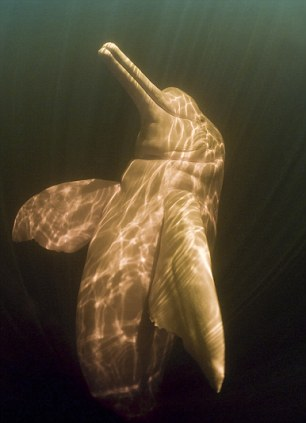
the Boto is well-adapted for river life, to the point where they’ve become mildly upsetting to look at. unlike their sleek badass ocean cousins, Botos are floppy flappy twisty turny blob creatures. their soft, flexible bodies allow them to navigate between tree roots and rocks like disjointed but effective muppets. they are also one of the only types of cetacean to have a functional neck, rather than the fused vertebrae most of them have to deal with. this is 1000% more disturbing than it sounds.
THIS IS VISCERALLY UPSETTING.
we’re just going to take a little bit of a break for a montage here because:
1) HOLY FUCK, and 2) JESUS FUCKING CHRIST LOOK AT IT. LOOK.
because of their muddy muddy river life, Botos have terrible eyesight and rely on their sonar to find prey. and they eat a wide variety of prey- from fish, to some other, slightly different fish.
despite this, Botos are a common sight in the rivers of South America, and are offered many protections across their range (probably due to that one legend that says that if you look one in the eyes, you will have nightmares for the rest of your life)
it’s the face, it’s gotta be
it just goes to show, there are many different ways to succeed, and no metric for success. you can always do well if you work with what you’ve got (and also have nightmare eyes).
That is private, personal, highly secret information.
Native religions are appropriated almost every time they let one piece of information slip to outsiders. As a result of being burned over and over and over again, tribes have become even more closed than they were previously.
Not only does it vary by tribe (we had no overreaching religion, so even your limitation of “plains” is far too general to even begin answering), it can vary by family, and it can vary right down to the individual.
Do not ask how we worship. We, collectively, have decided not to open up our worship, because as soon as outsiders are introduced, they steal. They write about things we tell them not to write about. They push beyond our clearly set boundaries.
On top of it, our relationships with our deities are highly personal. You will get as many answers as there are Native individuals.
If you want to show worship in your novels, skim over the barest of details that we have chosen to make public. Ask an individual tribe “what rituals are you comfortable being written about?” Only write about what they are comfortable being written. Let them know how far you plan on spreading the story, as their comfort level might change how large the audience is (ie- “I’m showing my group of friends” vs “I’m going to publish this”)
Do not ask how we worship.
That is not for you to know.
~ Mod Lesya
In relation to this question, what are your thoughts on books such as Kathleen O’Neal Gear and W. Michael Gear’s First North Americans series (People of the Wolf, etc.) Since the series tends to generalize in terms of religion (it covers tens of thousands of years and yet every featured tribe has a more-or-less similar belief system) do you think this series should be considered fantasy or alternate history as opposed to reconstructed history in terms of its portrayal of Native peoples?
I ask because I used to consider this a good model for writing about Native peoples (since both writers are archeologists and well versed in history), but now I’m not so sure.
It depends on a few things. Anthropologists’ accounts and archeologists’ accounts are often more credible, but they’re also not guaranteed to be safe. In fact, they can provide some of the worst violations of privacy for a tribe, or be some of the most colonialist-imposing fields out there. An important note is the archeology is a subset of anthropology, so I’m going to be talking about anthropology as a whole.
Also, I haven’t read the books and am going off the wikipedia summary.
My biggest question is: were the tribes populating the area actually asked for detailed oral histories, or was everything pieced together and the data sampled/ based on trends? A lack of oral history is a huge red flag since Indigenous oral histories around the world are exceptionally accurate. Sampling and trend-based data is another, since it really opens up a can of worms for making a whole bunch of educated assumptions instead of asking about details.
From a quick glance it seems that the data was heavily sampled based on colonizer views from purely archeological data without any oral history in sight, which… makes me question the validity. Because it seems to be our history without us.
I also am tilting my head at the “mystic” terms used, because they are very university-approved-speak. One of anthropology’s dirty little secrets is it’ll take one group’s practices and apply the name to all other groups’ practices because of superficial similarities— shaman, for example, is a Northeast Asian word, likely Tungusic, that described Northeast Asian practices. It has now spread across most if not all Indigenous practices, and sometimes doesn’t reflect accurately. Totem was another word, taken from Ojibwe and spread across anything that involved animal associations.
My impression of the books is basically a bunch of academics trying to make sense of Indigenous peoples based off fossil records, which is actually a huge problem in academia. Instead of treating our oral histories as valid, instead of asking us how our cultures have evolved over time, they’re treating us like we’re already dead and gone. Or that we can’t have any idea where we came from.
Another thing to keep in mind for anthropological records: sometimes they spread out secret rituals far wider than we ever intended. A Quebec Cree person once showed an image of a sacred Cree ritual, and prefaced it with “I am only showing you this because the person who took the image has already violated this man.” The image was supposed to only go to a small group. It ended up internationally published. That image is why I put in a note in the original ask that you need to say how far the story will be spread before asking about comfort levels. Not saying that happened with these books, but I am saying it does happen.
Calling these books “alternate history” discredits them, but “reconstructed history” is inaccurate as well— from the looks of things, they’re not so much alternate history as they are hollow reconstructed history, because it’s taken based on what colonizers know instead of asking us. It’s not Native American history in the purest sense. It’s a colonizer’s view of our history.
This is why I am very much in love with America Unearthed. Oral history is treated as valid, and whenever possible he either talks to the tribe directly, or makes note of their oral history. He’s done it for a possible Hawai’in contact with Mexico, the Aztecs coming from the Mississippian region, and a whole bunch of other groups.
But in general I distrust anything that is our history without us. We’re more than fossil records. Our history doesn’t have to be “reconstructed” in all cases. We know where we came from the vast majority of the time. If you want to know, just ask.
~ Mod Lesya
-Raises hand- If I may add, something else important to note is that there are tribes who will absolutely not discuss this type of thing through technological means. This means anything from a computer to a phone. I don’t know how far this spreads, but at least among the local tribes in my region, talking about culturally sensitive information, practices, the ‘mystic stuff’ through technological means is absolutely not done. I’ve been chastised by more than one elder for even alluding to something via text message. So if you’re finding your information online, be critical.
Yeah, these sorts of restrictions are in place among various tribes. They can also include no photography, no publishing, or other distribution limits.
Many, many, many Natives have pointed out (across various posts) that there’s a far more solid sense of ownership of stories and legends among tribes, so you can’t even distribute something if you were told it unless you have permission to tell it secondhand.
You should be critical of anything found online because of the aforementioned appropriation by new age movements I alluded to in the first post. This is why you should go directly to the tribe in question.




 tora42's nonsensne