From @whiskersnpurrs: “The kitten lovers have spoken!! By a landslide, the “white kittens want birthday cake” video was the most requested ☺️” #catsofinstagram [source: https://ift.tt/2zCRv6P ]
I just spent 2 hours debating and testing and arguing in circles and bitching about library catalogs with two colleagues and I just want to say
AO3’s website is really, really, really impressive, functional and ergonomic and cohesive. the tag system is INCREDIBLE and AMAZINGLY maintained. this is my professional librarian appraisal.
I’ve found 1 library catalog that meets my standards. even the national library of France’s catalog is shitty in comparison to ao3.
praise.
It’s awesome! As a total ignorant, can I ask what AO3 does and library catalogs don’t?
i might actually type out a longer answer but what it really boils down to is: YOU ACTUALLY FIND WHAT YOU’RE LOOKING FOR
ok so here’s the long unreadable (and probs uninteresting to anyone else than me) version:
– the site design and overall look. it’s easy to read, easy to navigate, and easy to notice what you can click on. Makes good use of fonts and text sizes and styles to make important things stand out and be easily found at a glance, and is just overall very readable. The icons with hovertext! The tags! the amount of info that’s readable at a single glance and actually fits on the same page!
this is BASIC STUFF and it is not a given on a LOT of professional library websites i run into regularly and that drives me INSANE. (Mostly bc one of the very popular, cheap, and easy French-language library catalog softwares has a default online catalog design that sucks and which librarians generally don’t tinker with much.)
– again this seems obvious, but the filters when you’re inside a fandom/tag are SO VISIBLE and SO EXPLICIT. The filters menu makes it instantly clear what it’s for, is easy to navigate and understand and use, intelligently suggests the most popular tags first (which also immediately gives you a lot of information).
My library’s online catalog (which uses the default website set-up I mentioned above) has exactly the same thing, but stupidly executed, unreadable and incomprehensible, and somehow completely unnoticeable despite being exactly in the same place on the page. The site design makes very bad use of the space on the page and basically you just don’t even look over there because it’s so far away from where the rest of the information is and it simply never catches your eye, and even when it does, the vocabulary used is so obtuse you don’t realize what it’s for.
IT’S SO… STUPID AND EASILY FIXABLE… but apparently no public library in the french language can afford a website designer, or they’re all horrifyingly bad
– and finally: THE TAGS. One of the biggest issues we have in catalogs is that people use different words for the same thing. In order for you to find books relevant to your search, we have to apply topic keywords to them (basically: tags), but of course there are Norms so that all libraries, or at least all employees in the same library, use the same keywords. Except despite the norm that still doesn’t happen. I don’t know how it goes in the English-language world but for French language it’s all horribly complicated and surprisingly non-functional, despite how easy it seems in theory, and leads me to complain about the Bibliothèque Nationale de France about once a week at least.
Easy example that I’ve complained about today (for the 6th time this year): ADHD. The term used by the BNF, that we are supposed to use, is “Trouble de l’hyperactivité avec déficit de l’attention” (“hyperactivity disorder with attention deficit”). That’s… not only outdated but flat-out inaccurate (according to French’s current stance on it) — the term people actually use nowadays is the opposite way around, “trouble de l’attention avec ou sans hyperactivité” ( “ADD with or without hyperactivity”), commonly abbreviated to “TDA/H”. The BNF’s system does accommodate for various synonyms, but it appears unaware of this one, so if you search “TDA/H” in the keywords, you won’t find anything. You’d have to look in the title, and if none of our books have it in their title, you’ll find nothing at all, and won’t even be redirected anywhere if we strictly follow the BNF system. (WHAT IS THE POINT OF KEYWORDS THEN, one might ask.)
Tl;dr: you look for the word you and most people actually informed about a topic use, and find nothing at all because some rando has decided that’s not the word you should be using. (Unsurprisingly, this problem pops up a looot for keywords related to minorities, mental illnesses and LGBT+ topics.)
It’s like if you tried to search a site for “fluff” and didn’t find anything because the site has decided to continue using “WAFF” instead. Also, the site has decided that hurt-comfort and guro fic are the same thing, makes no distinction between levels of romance and eroticism so there’s no way to tell cute handholding from smut, and believes that the word “furry” means they get a dog.
=> The system of letting people use their words and linking them — making them synonyms — with what other people have used for the same meaning completely blows my mind. I am in awe of the fact that it works, and that it’s still happening, even though iirc tag-wranglers are unpaid volunteers. I couldn’t imagine doing something like that in just our catalog, and AO3 is massive.
The result is: not only do you find what you’re looking for, but if your search accidentally picks up other things too, you know what it’s actually about because you get it in the author’s words.
AO3′s tag system is an incredibly clever and simple solution to a very real and thorny problem that I run into almost every day.
tl;dr AO3 is just generally a perfectly functional and user-friendly site, instantly easy to use in order to tailor your search to exactly what you want (and even more so with the addition of the exclusion operator to the filters sidebar), and on a technical library-science viewpoint, it’s fascinating.
This is taking me back to when AO3 was first born, and I was having a conversation with someone (@icarusancalion, I think?) about how I didn’t think the tagging system was ever really gonna be useful.
I knew the kind of top-down tagging system that libraries use was often useless for the same reasons you’re describing here: academics like the idea of a priori systems and exclusive classification schemata, but AO3 tagging is useful precisely because tags can be messy and overlapping rather than strict hierarchies. You’ll never get all fandoms everywhere to agree on a common tag family, I said c. 2008. It’ll be outdated before it’s even implemented. But relying entirely on user-generated tags will be a logistical nightmare, past!Maud also argued, because there would be no way to manage synonyms and near-synonyms and typos that would rapidly bloat the system to uselessness.
Well, 2008!me was right about top-down schemata but wrong about user-submitted tags, thanks almost entirely to the work of the tag wranglers: human curators who take the time to link and nest related tags as they come up, without relying on a pristine (and utterly dysfunctional) a priori system to do so.
Would real-world academic libraries benefit from tag wranglers? Absofuckinglutely, but I really don’t think most of them would ever implement them for the same reason past!me was skeptical of them. Maybe if they were shown how well it works on AO3 (where the wranglers are all volunteers!) they might be persuaded to hire some workstudies or under-employed PhDs to wrangle for them. And then the world would be a better place.
I have given talks about our “curated folksonomy,” which is what it’s called, to librarians and archivists! And @cfiesler has done great work re: tags and such!
Can confirm that AO3 is fascinating from a library perspective, and that librarians think it’s rad. I gave the keynote (talking about AO3) at a library conference on open repositories last summer and got such amazing reception!
But also, an academic friend did her dissertation in library science on tag wrangling in particular. Here’s one piece of that; I can’t immediately find an open access copy but I’m sure if anyone wants to read her work they can contact her and she’d be happy to share: https://dl.acm.org/citation.cfm?id=2957295
The eyes-in-the-front thing (usually) only applies to mammals. Crocodiles, arguably the inspiration for dragons, have eyes that look to the sides despite being a predator.
hey what up I’m about to be That Asshole
This isn’t a mammalian thing. When people talk about ‘eyes on the front’ or ‘eyes on the side,’ they’re really talking about binocular vision vs monocular vision. Binocular vision is more advantageous for predators because it’s what gives you depth perception; i.e, the distance you need to leap, lunge, or swipe to take out the fast-moving thing in front of you. Any animal that can position its eyes in a way that it has overlapping fields of vision has binocular vision. That includes a lot of predatory reptiles, including komodo dragons, monitor lizards, and chameleons.
(The eyes-in-front = predator / eyes-on-sides = prey thing holds true far more regularly for birds than it does for mammals. Consider owls, hawks, and falcons vs parrots, sparrows, and doves.)
But it’s not like binocular vision is inherently “better” than monocular vision. It’s a trade-off: you get better at leap-strike-kill, but your field of vision is commensurately restricted, meaning you see less stuff. Sometimes, the evolutionary benefit of binocular vision just doesn’t outweigh the benefit of seeing the other guy coming. Very few forms of aquatic life have binocular vision unless they have eye stalks, predator or not, because if you live underwater, the threat could be coming from literally any direction, so you want as wide a field of view as you can get. If you see a predator working monocular vision, it’s a pretty safe assumption that there is something else out there dangerous enough that their survival is aided more by knowing where it is than reliably getting food inside their mouths.
For example, if you are a crocodile, there is a decent chance that a hippo will cruise up your shit and bite you in half. I’d say that makes monocular vision worthwhile.
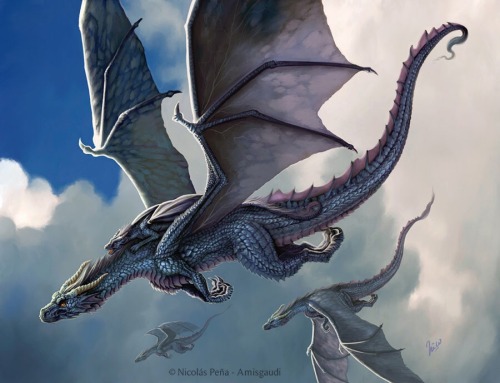
Which brings us back to OP’s point. Why would dragon evolution favor field of view over depth perception?
A lot of the stories I’ve read painted the biggest threats to dragons (until knights with little shiny sticks came along) as other dragons. Dragons fight each other, dragons have wars. And like fish, a dragon would need to worry about another dragon coming in from any angle. That’s a major point in favor of monocular vision. Moreover, you don’t need depth perception in order to hunt if you can breathe fucking fire. A flamethrower is not a precision weapon. If you can torch everything in front of you, who cares if your prey is 5 feet away or 20? Burn it all and sift among the rubble for meat once everything stops moving.
Really, why would dragons have eyes on the front of their heads? Seems like they’ve got the right idea to me.
this is some good dragon discourse right here, 10/10, and i dont mean to derail the whole thing away from the eyes, but i feel obligated to mention that in many stories and accurate to some reptiles, dragons have an extremely acute sense of smell/taste which would definitely help narrow down the depth perception issue. things smell stronger the closer they are. and i feel like i read somewhere that a blind snake can flick the air with its tongue and track its target mouse with no trouble at all. gotta imagine the “great serpents of the sky” had some pretty advanced biology. enough to make field of view win out against depth perception.
anywho. cool stuff. fear the dragons even if they are the prey cause they still beat us on the food chain.
Role swap au where Zuko was the Avatar who got frozen for a hundred years, so when he’s rescued from the ice instead of a goofy twelve year old Katara catches this mysterious teenager with long hair and a cool scar and a fucking DRAGON
Katara: BOY???? HOT BOY?????? HOT TEENAGE BOY?????????
Zuko: *speaks*
Katara: nevermind I hate him
How does Aang factor into this? I ask because the more I think about it the more I want him to somehow be trying to capture the Avatar.
Aang is 112 years old, decided he was going to be Zuko’s airbending teacher, and refuses to take no for an answer
Aang: Aw, the new Avatar doesn’t want me. Aang: *gets out a weighted net* Time for Plan B then.
JDJSHJABDBFJSH
Look, you know how you keep a net from falling on you? YOU AIRBEND IT, SUCKA. Air comes right after fire in the cycle so it’s not like the guy has any other options. Do you want a flaming net falling on you? No? Then learn to airbend. Or this tiny old man will cart you away like a trussed turkey and lecture you about the power of laughter, going with the flow, opening your chakras, and other hippie shit.
Sokka, slouching against a fence, not moving: Oh nooooooo, that creepy old man stole the Avataaaaaaaaaar. Sokka, sitting down on the ground: We should dooooo something. Sokka, pulling out his lunch: Otherwise he might actually learn something. That would be teeeerrible. Katara, indignant rage coursing through her body: Sokka!!!!!!!! We have to go look for him!!!! Sokka: Might! Actually! Learn! Something! Katara! Katara: *wavers* Katara, also sitting down: We have to go look for him…. *gets out her own sandwich* But, maybe after lunch.
I love that this transforms Aang’s role in the full Team Avatar familial situation from the baby of the family to the Grandpa with weird hobbies
my Iroh thoughts for this
– Zuko is angry, he’s still him – he finds Iron’s diaries, there’s a quest, maybe they were in that big Library and Zuko has to make a choice – ‘Young Avatar, you can take knowledge with you or you can take understanding’ – Zuko doesn’t understand the nature of the choice really and takes Iroh’s diaries because Azula ended up taking over the Fire Nation and things progressed as they had before but – Iroh became one of the chief Firebenders rebelling against her rule – so Zuko figures Iroh’s diaries would have the info they need – because maybe the whole ‘eclipse equals less fire-bendiness’ was something Zuko didn’t know? – yeah, let’s go with that – instead, Zuko gets Iroh’s thoughts – Iroh’s grief, his worry, his hopes that his beloved nephew is okay, where ever he is – Zuko reads the passages where Iroh talks about how much he loved Zuko and how much he worried about Zuko’s anger poisoning him and how much he hoped for him -and how much Iroh believed that Zuko, if he overcame his anger, would be the very best of them, the best representative of all that was good about the Fire Nation
– Zuko never knew
– he never had anyone tell him that they were proud of him
– and here’s Iroh, reaching out from a hundred years in the past, saying ‘I believe in you. I’m proud of you. I love you.’
– and just like in canon, Iroh gives Zuko the love and support he needs to become the best, most socially awkward, version of himself
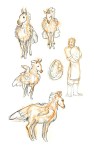
They come from eggs and are smaller than normal foals?? I have no idea yet. None of these ideas are concrete, but @howling-sage made me want to draw these little guys after this ask. I definitely want to put more thought into the foals/chicks of pegasi, but it may have to come after the anthology.













 tora42's nonsensne